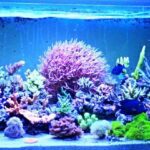
Your tank has cycled, the clownfish are eating, and the coral frag tank at the local shop is calling your name. So which corals will forgive the mistakes every new reefer makes in the first year: a lamp turned up too fast, a pump pointed the wrong way, a salinity swing after a busy week? For most of us the honest answer is soft corals.
Here are five forgiving groups, where each one goes, the catch each carries, and why corals fade or close up.
What actually counts as “soft corals”?
In a shop, “softie” means almost anything without a stony skeleton. Biologists are pickier.
- True soft corals are octocorals. Members of the class Octocorallia have polyps with eight tentacles, a number that never varies within the class, and those tentacles are usually pinnate, fringed like a tiny feather [1]. The group holds about 3,500 species, including soft corals, sea fans and sea pens [1]. Most octocorals form small calcium carbonate spicules (sclerites) inside their tissues [1][2], and few build a substantial skeleton, which is why many are called soft [2]. Leathers, xeniids and green star polyps belong here.
- Zoanthids are not octocorals. The order Zoantharia sits in a different subclass, Hexacorallia, and is most closely related to sea anemones [3].
- Mushrooms are not octocorals either. Corallimorpharians lack a mineralised skeleton, yet phylogenomic analyses group them closely with the stony corals [4].
So “soft corals” in the hobby sense is a shopping category, not a family tree. A mushroom is closer to an Acropora than to a leather coral [2][4], and their catches differ accordingly.
Start here. Pick two or three of the groups below, not all five. Buy small frags that are already open in the shop tank, place them low in the rock work with gentle flow, leave a hand’s width between colonies, and change one thing at a time. If you keep zoanthids, wear gloves, eye protection and a mask whenever you work with them [14].
Ten words you’ll hear in the coral shop
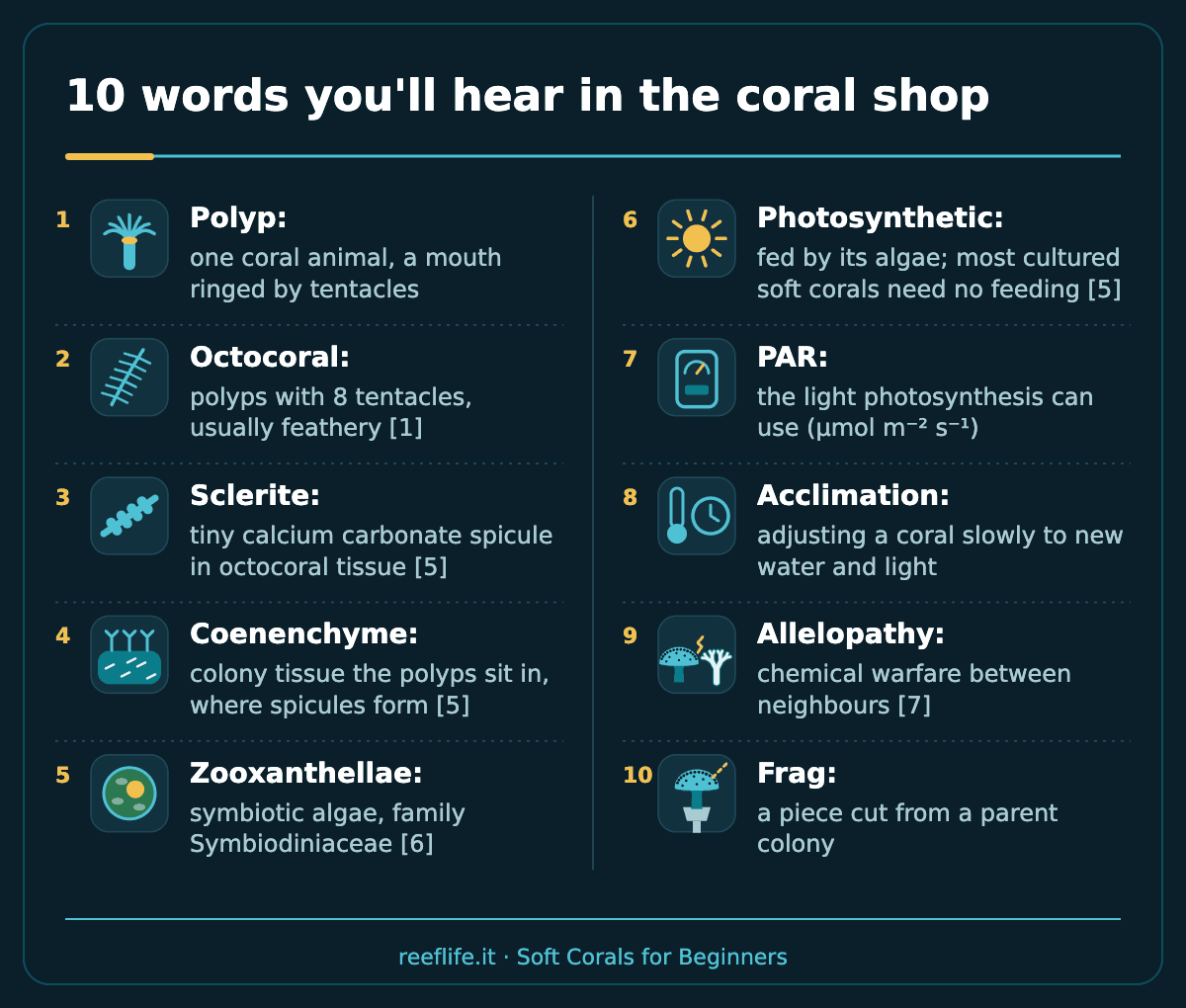
- Polyp: a single coral animal: a mouth ringed by tentacles. A colony is many polyps joined together.
- Octocoral: a coral whose polyps have eight, usually feathery, tentacles [1].
- Sclerite (spicule): a tiny calcium carbonate element inside octocoral tissue. Sclerites differ in shape and size and are used to identify species [5].
- Coenenchyme: the mass of colony tissue in which an octocoral’s polyps are embedded; special cells called amebocytes secrete the calcium carbonate spicules into it [5].
- Zooxanthellae: the single-celled algae living inside coral tissue. Scientists place them in the family Symbiodiniaceae, which a 2018 revision split into several genera that were previously all lumped under Symbiodinium [6]. Our guide to zooxanthellae goes deeper.
- Photosynthetic: describes a coral that gets food from its algae. Most commonly cultured soft corals are photosynthetic and do not have to be fed [5].
- PAR: the light that photosynthesis can use, usually measured in µmol per square metre per second. See PAR for the reef.
- Acclimation: letting a coral adjust slowly to your water and light instead of dropping it straight under full intensity.
- Allelopathy: chemical warfare: one organism releasing compounds that harm another, even without touching it [7].
- Frag: a fragment cut from a parent colony and grown on a plug or small rock.
Five easy soft corals worth starting with
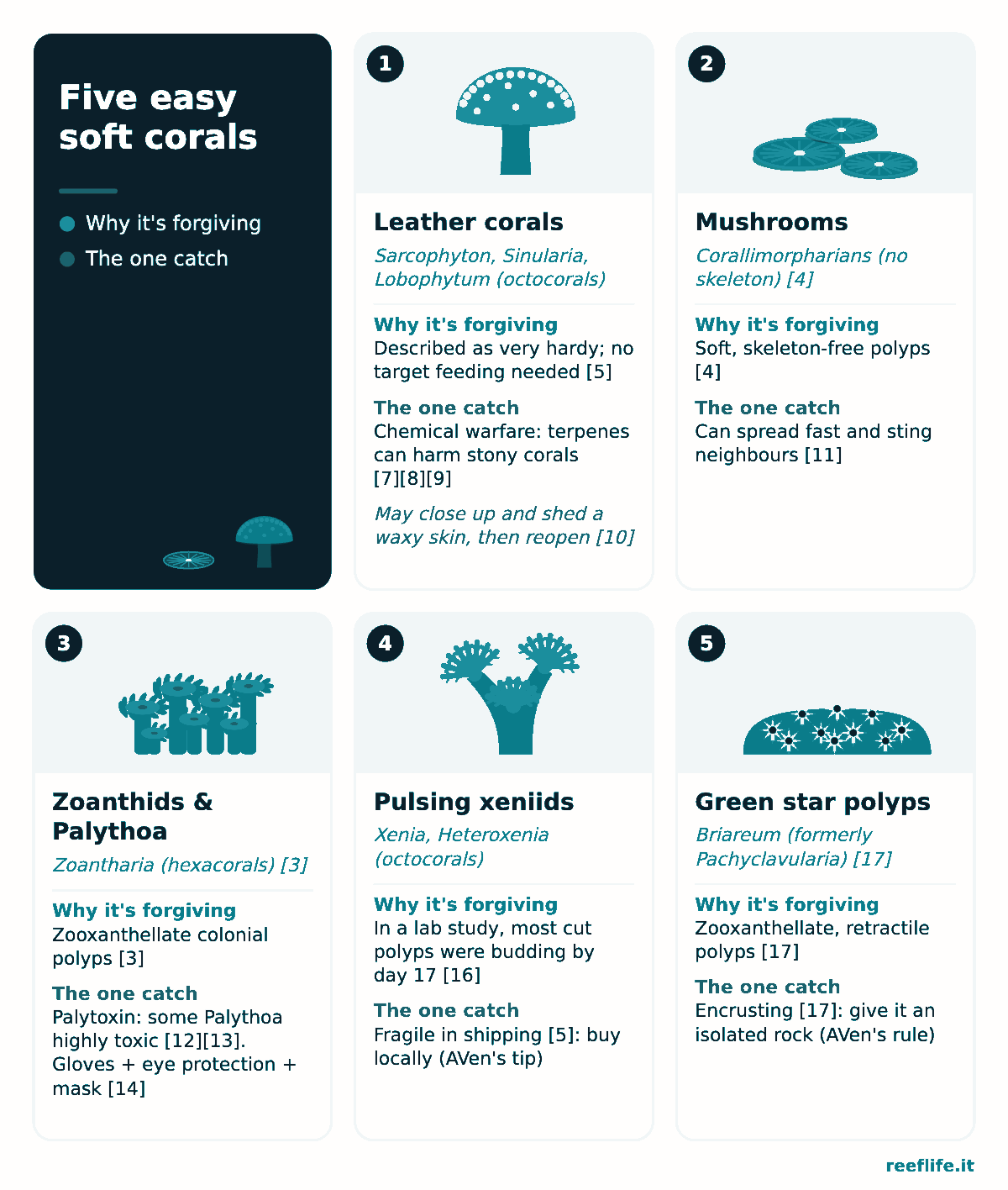
A Hawaii Sea Grant manual on farming soft corals for the aquarium trade describes many species of Sarcophyton, Lobophytum, Sinularia and Cladiella as “very hardy” and opportunistic, and adds that they survive well in reef tanks [5]. Hardy is not the same as indestructible, though, so each profile ends with the catch.
1. Leather corals: the forgiving workhorses
Toadstool leathers (Sarcophyton), finger leathers (Sinularia) and devil’s hand leathers (Lobophytum) are the classic first leather coral choices. They are fleshy, photosynthetic, and the farming manual counts them among the very hardy genera [5].
The catch: chemistry. In one experiment, Lobophytum pauciflorum caused significant mortality in the stony coral Porites andrewsi without touching it [7]. Diterpenes from Sinularia flexibilis, tested in the lab at 5 and 10 ppm, made most eggs of the stony corals Acropora tenuis and Montipora digitata that were fertilised in their presence burst within hours [8]. On the reef, fewer stony coral spat settled around S. flexibilis and Sarcophyton glaucum than around controls, and their spread was lopsided in line with the prevailing current [9]. These are reef and lab results, not tank measurements, but they explain why leathers and stony corals are often kept apart.
Leathers also have a habit that frightens beginners: they occasionally pull in their polyps, grow a waxy mucus coat and shed it, usually looking better afterwards [10]. A coral that stays shut for an unusually long time, however, is telling you something is wrong [10].
2. Mushrooms: the quiet spreaders
Mushrooms (Discosoma, Rhodactis and relatives) are corallimorpharians: soft, skeleton-free polyps that are anatomically similar to both sea anemones and stony corals [4]. In AVen’s view they are the obvious tenants for the shadier lower rocks of a young tank.
The catch: they can take over. On Palmyra Atoll, the corallimorpharian Rhodactis howesii dominated the reef around a shipwreck, where coral cover near the wreck was below 1%, and its marginal tentacles caused tissue necrosis on corals they touched [11]. Corallimorpharians as a group can clone themselves by fission, pedal laceration and budding, which lets them take over space quickly [11]. A reef is not a 200-litre tank, but the lesson travels: keep mushrooms on their own rock where you can remove them.
3. Zoanthids and Palythoa: colour, with a safety rule
Zoanthids are colonial hexacorals; the family Zoanthidae is entirely zooxanthellate, while Palythoa embeds sand and detritus in its body wall [3].
The catch: palytoxin. When researchers bought zoanthids from three US aquarium shops, four Palythoa specimens were highly toxic, at roughly 0.5 to 3.5 mg of crude toxin per gram of wet tissue; the other eleven samples, including the Zoanthus colonies, were non-toxic or only weakly toxic [12]. The same paper stresses that aquarium zoanthids are hard to identify and are often sold under common names [12]. In Anchorage, Alaska, at least ten people developed suspected palytoxin poisoning in three clusters linked to zoanthids in two homes and an aquarium shop, with symptoms ranging from a metallic taste and cough to, in one hospitalised patient, loss of consciousness [13]. Eye exposure can happen when a colony squirts directly into the eye [14].
- Wear gloves, eye protection and a mask when working with zoanthids, and never rub your eyes with hands that have touched the coral [14].
- Never pour hot or boiling water on zoanthid rock or boil it, and avoid scrubbing it: hot-water removal has been linked to poisonings, and health investigators warn that scrubbing could also aerosolise palytoxin [12][13][14]. Cutting polyps, cleaning the tank and handling rock out of the water have also been linked to exposures, so wear protection for those jobs too [13].
- The Alaska investigators note that palytoxin can be neutralised by soaking coral for 30 minutes in a fresh bleach solution of 1 part household bleach (5–6% sodium hypochlorite) to 10 parts water, and that contaminated items should be soaked in diluted bleach before disposal. They advised one affected household to wear a face mask, goggles and overalls while decontaminating surfaces with bleach, while noting that no official evidence-based protective-equipment recommendations exist for hobbyists [13].
- If you feel ill after working on zoanthids, seek medical advice and mention the coral; health officials ask for such illnesses to be reported promptly [13].
4. Pulsing xeniids: the hypnotic one
Pulsing Xenia and Heteroxenia open and close their polyps like hands grasping water. That movement is not decoration: in lab experiments on Heteroxenia fuscescens, net photosynthesis while pulsing was up to ten times higher than when the coral stopped, apparently because pulsing flushes oxygen away from the tissue [15]. In another lab study, Xenia umbellata was kept at a modest 42 to 57 µmol m⁻² s⁻¹; polyps cut from the colony reattached within two to three days, and by day 17 most of them (70%) were budding new polyps [16]. In AVen’s view, that quick growth under gentle light is what makes them forgiving.
The catch: they are fragile in transport, and the Hawaii farming manual notes that xeniids often do poorly during shipping [5]. Buy them locally, already pulsing, and treat that rapid budding as a reason to give them their own rock.
5. Green star polyps: the living carpet
Green star polyps belong to the genus Briareum; the older genus name Pachyclavularia has been merged into Briareum [17]. Briareum colonies can be lobed or encrusting, their polyps retract, and the genus hosts zooxanthellae, which ties it to shallow, well-lit water in the wild [17].
The catch: in AVen’s view, “encrusting” is the warning label. Treat a GSP colony like ivy: place it on an isolated rock, or on a rock you are happy to see covered.
| Group | What makes it forgiving | The one catch |
|---|---|---|
| Leather coral (Sarcophyton, Sinularia, Lobophytum) | Described as very hardy; no target feeding [5] | Terpene “chemical warfare” against stony corals [7][8][9]; periodic shedding [10] |
| Mushrooms (corallimorpharians) | Skeleton-free; corallimorpharians can clone themselves in several ways [4][11] | Can overrun space and sting neighbours [11] |
| Zoanthids and Palythoa | Zooxanthellate colonial polyps [3] | Palytoxin risk, especially some Palythoa [12][13] |
| Pulsing xeniids | Fast budding under modest lab light [16] | Fragile in shipping [5] |
| Green star polyps (Briareum) | Zooxanthellate, retractile polyps [17] | Encrusting growth form [17] |
Placing soft corals: light, flow and elbow room
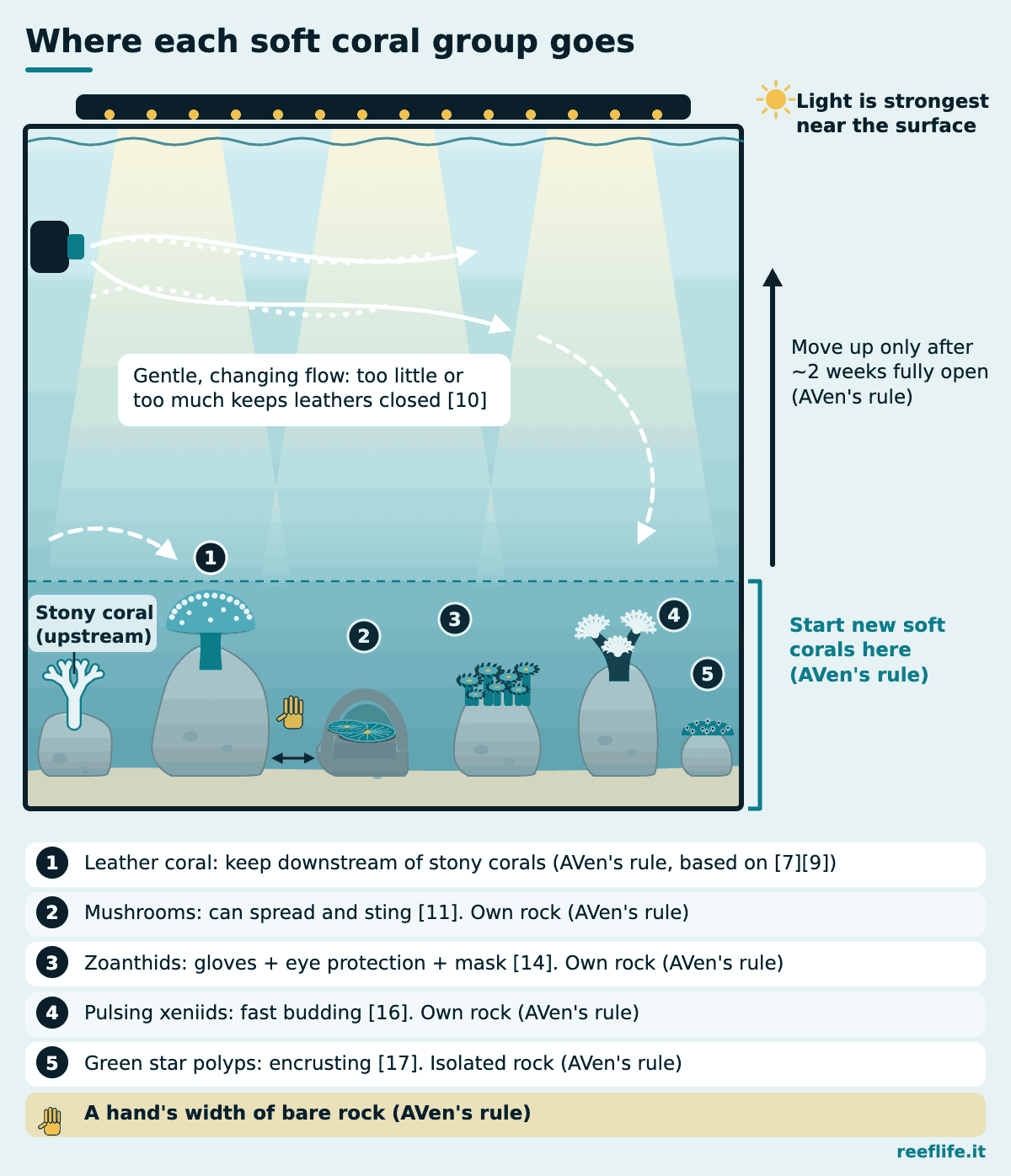
Start low, then move up
Photo shock, a sudden jump in light from a new fixture or a fast ramp-up, is one of the common reasons a leather refuses to open [10]. Even the farming manual warns that extremely bright light can harm soft corals newly brought from the ocean [5]. AVen’s rule of thumb: place new arrivals in the lower third of the tank and move them up only after a couple of weeks fully open. If you have a PAR meter, our PAR guide explains how to map your tank.
Gentle, changing flow
Too little flow and too much flow can both keep a leather closed, as can a pump blasting at one spot all day [10]. Aim for movement that sways polyps rather than flattening them. The basics are in mastering the flow.
Respect the chemical warfare
Because leather corals can harm stony corals without contact [7] and their effect on the reef appears to follow the current [9], AVen’s rule is simple: give every colony a hand’s width of bare rock, never place leathers upstream of stony corals, and keep mushrooms, GSP and xeniids on separate rocks.
Why soft corals lose colour, and what really controls it
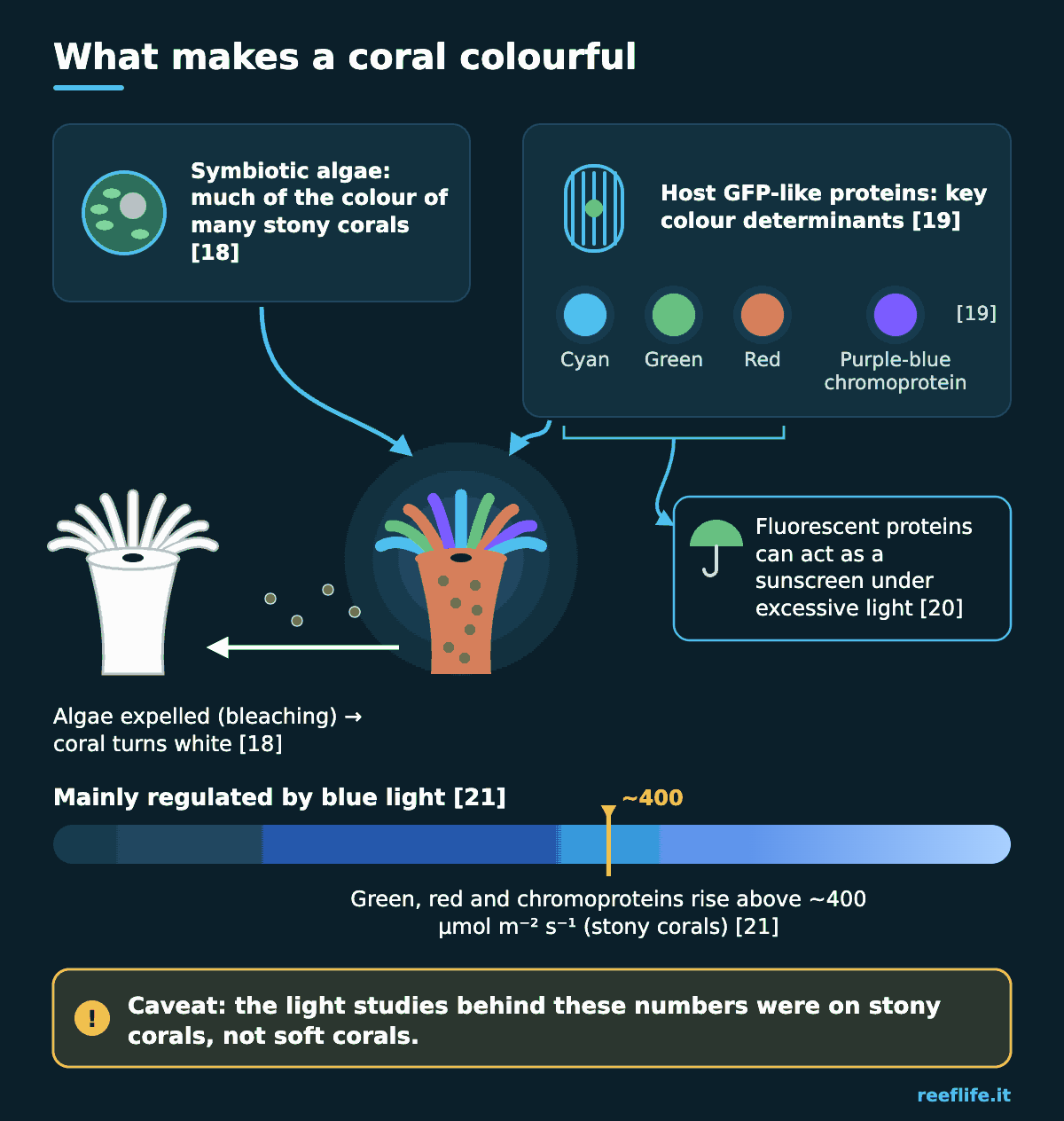
Colour in a coral comes from two partners. The symbiotic algae are responsible for much of the colour of many stony corals, and a coral that expels them during bleaching turns white [18]. On top of that, the animal itself makes GFP-like proteins, which a large study called the key colour determinants of reef-building corals: cyan, green and red fluorescent proteins plus non-fluorescent purple-blue chromoproteins [19]. Those pigments are not just pretty: the fluorescent ones can act as a sunscreen under excessive light [20], and in stony corals some of them are produced mainly in response to blue light, with green, red and chromoprotein levels rising only above about 400 µmol m⁻² s⁻¹ [21].
An honest caveat: the light experiments behind those numbers were done on stony corals, not on soft corals [20][21]. They explain why colour follows light, but nobody should promise you a specific PAR that “colours up” a leather. Colour and nutrients are also linked, a topic we cover in coral coloration: some important points and managing nutrients.
In practice, a coral that turns pale or closes up is reacting to a change, so check what moved last: light, flow, a neighbour or a parameter. Our list of essential water parameters covers what to test first.
What to ignore for now
- A shelf of supplements. Dosing several products without knowing what they do is on the list of reasons leathers stay closed [10]. Stable basics beat bottles.
- Target feeding. The commonly cultured photosynthetic soft corals do not need it [5].
- Chasing PAR numbers for colour. The precise light thresholds in the literature come from stony corals [21].
- Rare named morphs. In AVen’s view, a €100 zoanthid teaches you nothing a €10 one won’t.
- Fragging. Cut soft corals planted too soon can suffer necrosis and bacterial infection, and healing may take up to two weeks [5]. Learn to keep them first, then learn to cut them.
Your first soft corals in six steps
- Choose two groups from the five above; AVen would start with a leather and a mushroom rock.
- Buy small frags that are open in the shop, remembering that zoanthid trade names say little about the species [12].
- Place them low, in gentle flow, a hand’s width from anything else.
- Keep light and flow unchanged for the first couple of weeks (AVen’s habit); if a leather closes and sheds, wait before acting [10].
- Keep gloves, safety glasses and a mask next to the tank before the first zoanthid arrives [14].
- Move a coral up only after it has been fully open for a while, one coral at a time.
Get these basics right, and soft corals will give you a reef that moves, glows and forgives: easy soft corals are the best teachers you’ll ever buy.
References
- World List of Octocorallia / World Register of Marine Species (WoRMS). (accessed 2026). Octocorallia. marinespecies.org. https://www.marinespecies.org/octocorallia
- University of California Museum of Paleontology. Introduction to the Octocorallia. UCMP Berkeley. https://ucmp.berkeley.edu/cnidaria/octocorallia.html
- Low MEY, Sinniger F, Reimer JD. (2016). The order Zoantharia Rafinesque, 1815 (Cnidaria, Anthozoa: Hexacorallia): supraspecific classification and nomenclature. ZooKeys 641:1-80. https://doi.org/10.3897/zookeys.641.10346
- Lin MF, Chou WH, Kitahara MV, Chen CLA, Miller DJ, Forêt S. (2016). Corallimorpharians are not “naked corals”: insights into relationships between Scleractinia and Corallimorpharia from phylogenomic analyses. PeerJ 4:e2463. https://doi.org/10.7717/peerj.2463
- Ellis S, Sharron L. (1998). The Culture of Soft Corals (Order: Alcyonacea) for the Marine Aquarium Trade. Center for Tropical and Subtropical Aquaculture / Hawaii Sea Grant (HAWAU-H-98-003). NOAA Institutional Repository. https://repository.library.noaa.gov/view/noaa/35519
- LaJeunesse TC, Parkinson JE, Gabrielson PW, Jeong HJ, Reimer JD, Voolstra CR, Santos SR. (2018). Systematic revision of Symbiodiniaceae highlights the antiquity and diversity of coral endosymbionts. Current Biology 28(16):2570-2580.e6. https://doi.org/10.1016/j.cub.2018.07.008
- Sammarco PW, Coll JC, La Barre S, Willis B. (1983). Competitive strategies of soft corals (Coelenterata: Octocorallia): allelopathic effects on selected scleractinian corals. Coral Reefs 1:173-178. https://doi.org/10.1007/BF00571194
- Aceret TL, Sammarco PW, Coll JC. (1995). Effects of diterpenes derived from the soft coral Sinularia flexibilis on the eggs, sperm and embryos of the scleractinian corals Montipora digitata and Acropora tenuis. Marine Biology 122:317-323. https://doi.org/10.1007/BF00348945
- Maida M, Sammarco PW, Coll JC. (1995). Effects of soft corals on scleractinian coral recruitment. I: Directional allelopathy and inhibition of settlement. Marine Ecology Progress Series 121:191-202. https://www.int-res.com/abstracts/meps/v121/p191-202
- Kurtz J. (2013). 5 common reasons leather corals refuse to expand. Reef Builders. https://reefbuilders.com/2013/12/30/5-common-reasons-leather-corals-refuse-to-expand
- Work TM, Aeby GS, Maragos JE. (2008). Phase shift from a coral to a corallimorph-dominated reef associated with a shipwreck on Palmyra Atoll. PLoS ONE 3(8):e2989. https://doi.org/10.1371/journal.pone.0002989
- Deeds JR, Handy SM, White KD, Reimer JD. (2011). Palytoxin found in Palythoa sp. zoanthids (Anthozoa, Hexacorallia) sold in the home aquarium trade. PLoS ONE 6(4):e18235. https://doi.org/10.1371/journal.pone.0018235
- Hamade AK, Deglin SE, McLaughlin JB, Deeds JR, Handy SM, Knolhoff AM. (2015). Suspected palytoxin inhalation exposures associated with zoanthid corals in aquarium shops and homes — Alaska, 2012-2014. MMWR Morbidity and Mortality Weekly Report 64(31):852. Centers for Disease Control and Prevention. https://www.cdc.gov/mmwr/preview/mmwrhtml/mm6431a4.htm
- Hastings J, Moshirfar M, Ronquillo YC, Bunya VY, Weissbart SB. (reviewed 2026). Palytoxin Keratitis/Keratoconjunctivitis (Coral Keratitis). EyeWiki, American Academy of Ophthalmology. https://eyewiki.aao.org/Palytoxin_Keratitis/Keratoconjunctivitis_(Coral_Keratitis)
- Kremien M, Shavit U, Mass T, Genin A. (2013). Benefit of pulsation in soft corals. Proceedings of the National Academy of Sciences USA 110(22):8978-8983. https://doi.org/10.1073/pnas.1301826110
- Nadir E, Lotan T, Benayahu Y. (2023). Xenia umbellata (Octocorallia): a novel model organism for studying octocoral regeneration ability. Frontiers in Marine Science 10:1021679. https://doi.org/10.3389/fmars.2023.1021679
- Samimi-Namin K, van Ofwegen LP. (2016). Overview of the genus Briareum (Cnidaria, Octocorallia, Briareidae) in the Indo-Pacific, with the description of a new species. ZooKeys 557:1-44. https://doi.org/10.3897/zookeys.557.6298
- NOAA National Ocean Service. Corals tutorial: Zooxanthellae. NOAA Ocean Service Education. https://oceanservice.noaa.gov/education/tutorial_corals/coral02_zooxanthellae.html
- Alieva NO, Konzen KA, Field SF, Meleshkevitch EA, Hunt ME, Beltran-Ramirez V, Miller DJ, Wiedenmann J, Salih A, Matz MV. (2008). Diversity and evolution of coral fluorescent proteins. PLoS ONE 3(7):e2680. https://doi.org/10.1371/journal.pone.0002680
- Salih A, Larkum A, Cox G, Kühl M, Hoegh-Guldberg O. (2000). Fluorescent pigments in corals are photoprotective. Nature 408:850-853. https://doi.org/10.1038/35048564
- D’Angelo C, Denzel A, Vogt A, Matz MV, Oswald F, Salih A, Nienhaus GU, Wiedenmann J. (2008). Blue light regulation of host pigment in reef-building corals. Marine Ecology Progress Series 364:97-106. https://doi.org/10.3354/meps07588
About the author. AVen (Alessandro) is a reef keeper and the author of Reef Life. Read more about AVen.