A calcium reactor is one of the most effective ways to keep calcium and alkalinity stable in a reef tank with a high coral demand. It uses carbon dioxide (CO2) to slowly dissolve calcium carbonate media, and it returns that dissolved material to the aquarium in roughly the same proportions that corals use. This guide explains how a calcium reactor works, how to set it up and tune it, and which problems to watch for.
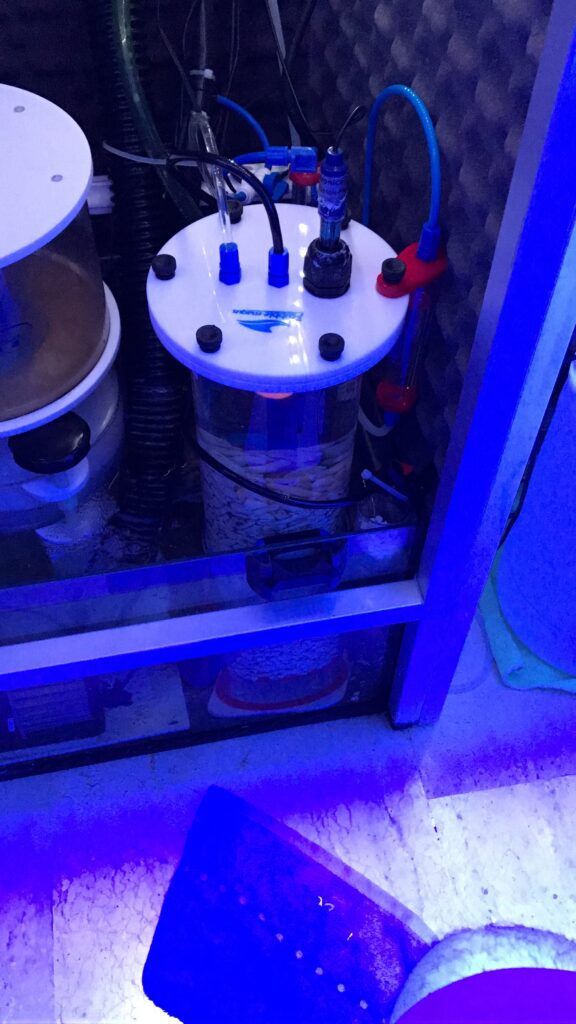
What is a calcium reactor and why does it matter?
Stony corals, coralline algae, clams and other calcifying organisms build their skeletons from calcium carbonate (CaCO3). To do this, they take calcium and bicarbonate ions from the water and transport them to the site where the skeleton grows [1]. In a closed aquarium, these ions are not replaced automatically. Every millimetre of new coral growth removes calcium and alkalinity from the water.
If you do not replace them, both fall. Alkalinity usually shows the drop first, because the same uptake is a much larger fraction of the alkalinity in the water than of the calcium. Laboratory work on a stony coral showed that its calcification rate depends strongly on the aragonite saturation state of the water [2], so letting calcium and alkalinity drop can slow growth. In a tank full of fast-growing SPS, demand can be high enough that water changes alone cannot keep up. If you are new to these parameters, the article on alkalinity and coral calcification explains the background, and the guide to the triad in the marine aquarium covers how calcium, alkalinity and magnesium work together.
A calcium reactor solves the problem by doing the opposite of what corals do: it dissolves calcium carbonate. Because the media is mostly the same mineral that corals build, the reactor returns calcium and alkalinity in a balanced way. Natural media also contains small amounts of magnesium, strontium and other elements, which dissolve together with the calcium carbonate [3].
How does a calcium reactor work? The chemistry
Reef water at a normal pH of around 8 or above is supersaturated with calcium carbonate, so the media does not dissolve on its own. The reactor makes it dissolve by lowering the pH inside a closed chamber. CO2 gas is injected into the chamber, where it reacts with water to form carbonic acid. This acidic water attacks the media:
CaCO3 + CO2 + H2O → Ca2+ + 2 HCO3−
For every calcium ion released, two bicarbonate ions are formed. Bicarbonate is the main form of alkalinity in seawater. So for every mole of calcium released, the water gains two equivalents of alkalinity. This is the same balance that calcification removes [3]. In hobby units, it works out to about 7 ppm of calcium for each 1 dKH of alkalinity (1 dKH = 0.357 meq/L, and 1 meq/L of alkalinity pairs with about 20 ppm of calcium).
This is the key advantage of a calcium reactor: if the media is pure calcium carbonate, you cannot easily push calcium and alkalinity out of balance with each other. You only have to control how much the reactor delivers.
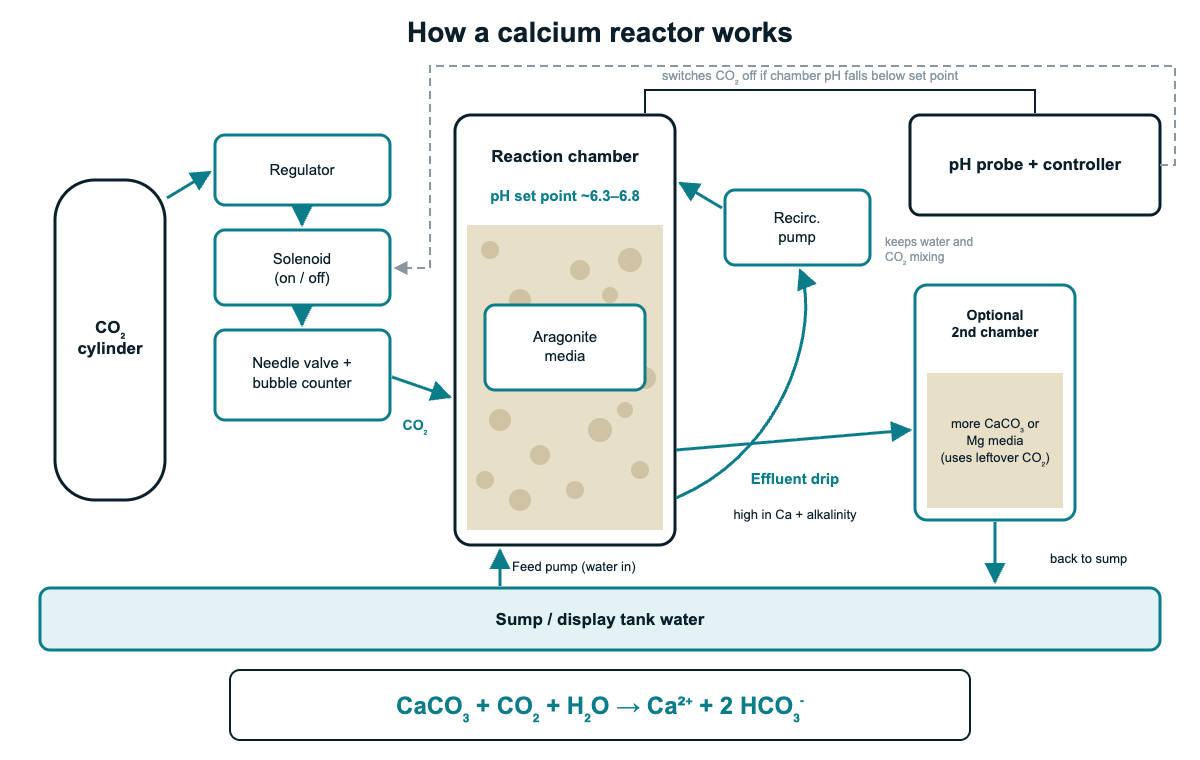
Calcium reactor components
Most commercial reactors use the same basic parts [4]:
- Reaction chamber. A sealed cylinder, usually acrylic, that holds the media. Tank water and CO2 mix inside it.
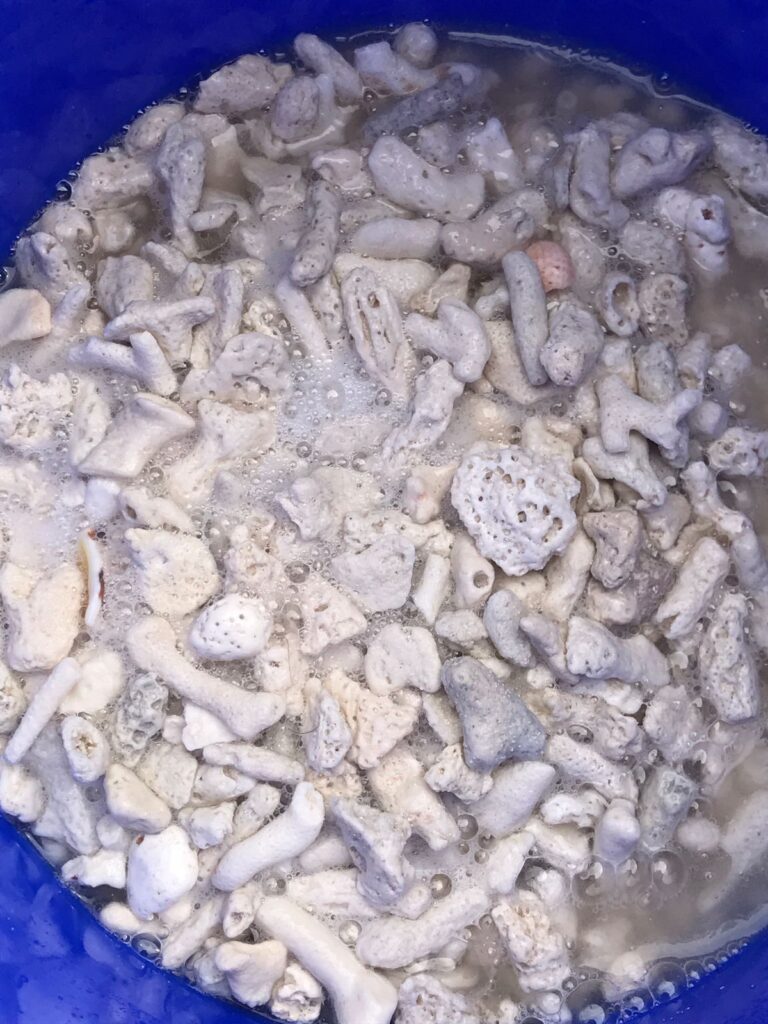
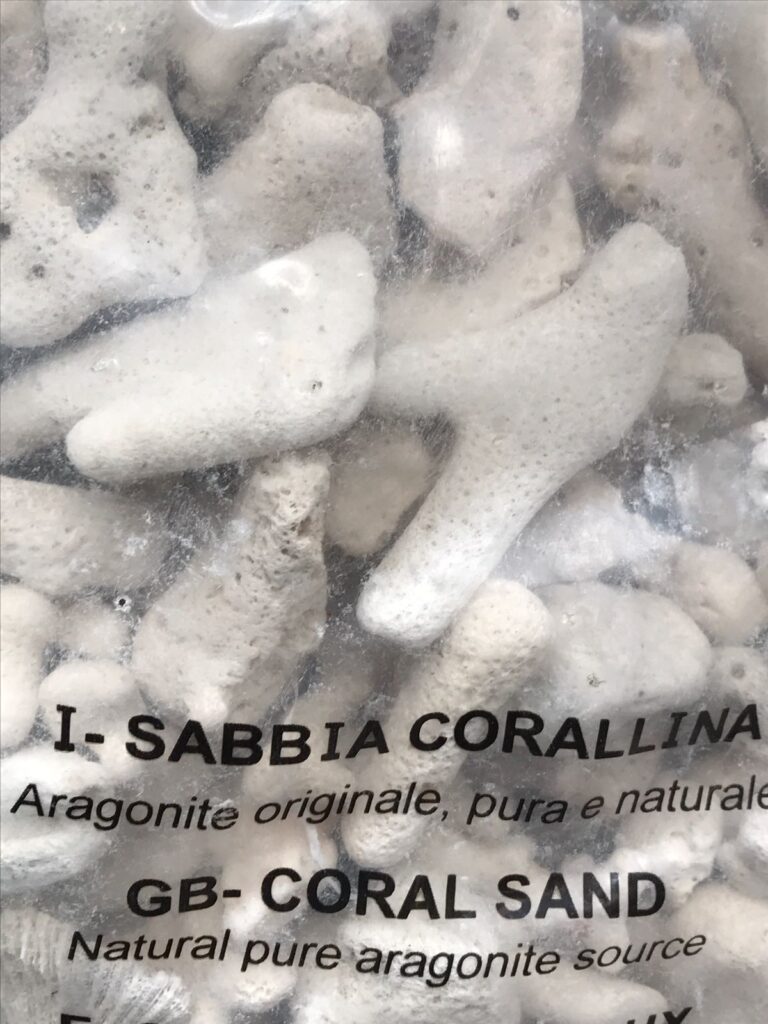
- Media. Usually aragonite or crushed coral skeleton. Aragonite dissolves more readily than calcite [3]. Media quality matters, because impurities in it end up in your tank.
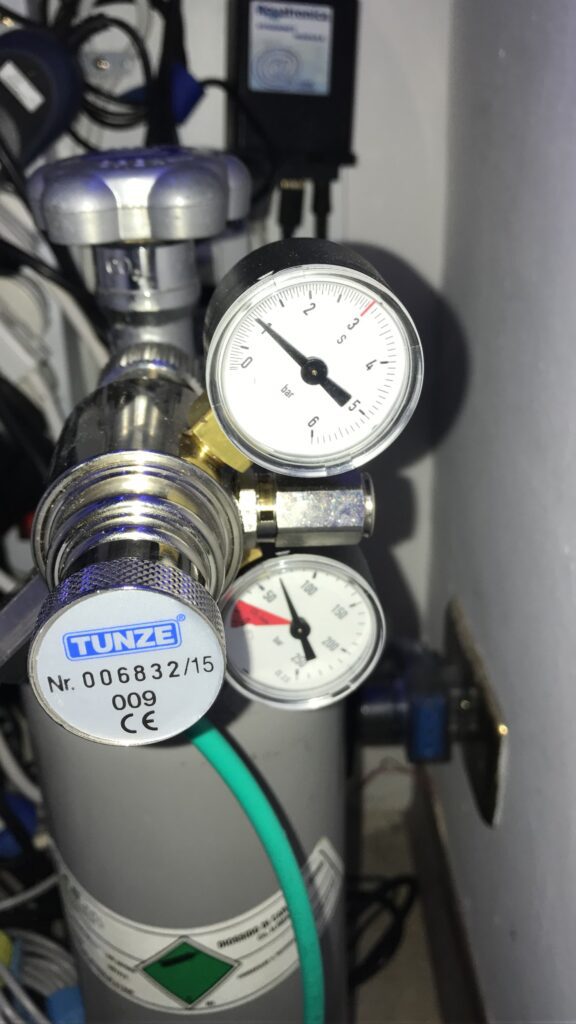
- CO2 cylinder and regulator. The regulator reduces the high cylinder pressure to a low, stable working pressure. A check valve in the gas line stops water from flowing back into the regulator [4].
- Solenoid valve. An electric valve on the regulator that opens or closes the CO2 flow.
- Needle valve and bubble counter. The needle valve sets the gas flow precisely. The bubble counter lets you see and count the rate.
- Feed and recirculation pumps. A feed pump (or a peristaltic pump) controls how much tank water passes through the reactor. A recirculation pump keeps the water and CO2 moving through the media inside the chamber.
- pH probe and controller. The probe measures pH inside the chamber or in the effluent. The controller switches the solenoid on and off to hold a set point [4].
- Optional second chamber. A chamber, usually smaller, after the main one, without CO2 injection. It is filled with more calcium carbonate or with magnesium media. Its job is to use up some of the leftover CO2 and raise the effluent pH before the water reaches the tank [5].
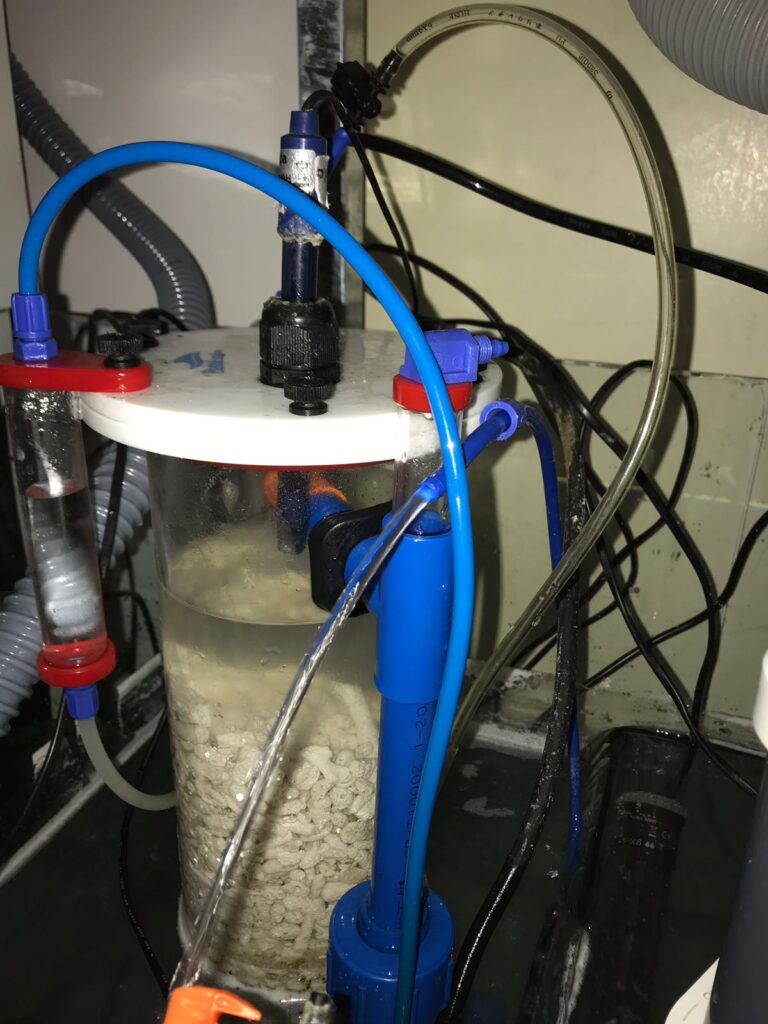
Choosing the media
Use media made for calcium reactors from a reliable brand. Low-quality media can contain phosphate, and some media can also contain trace metals such as copper [3]. Since the reactor dissolves nearly everything in the media, these impurities go straight into your water. Grain size is also important: very fine media packs tightly, slows the flow and turns to mush faster.
Setting up and tuning a calcium reactor
A calcium reactor has two main controls. Once you understand them, tuning becomes much easier:
- Chamber pH (set by the CO2 rate). Lower pH dissolves more media, so each millilitre of effluent carries more calcium and alkalinity. This sets the strength of the effluent.
- Effluent flow rate. More flow means more effluent reaches the tank each day. This sets the quantity delivered.
Delivery to the tank is roughly strength × flow. A common approach is to fix the chamber pH and then use the flow rate to match your tank’s demand [6].
Step-by-step tuning
- Start with balanced water. Bring tank alkalinity and calcium into your target range first. Many reefers keep alkalinity around 7–9 dKH, calcium around 400–450 ppm and magnesium around 1250–1400 ppm. The Reef Tank Calculator helps you check volumes and corrections.
- Run the reactor without CO2 first. Let water flow through new media for a while to rinse out fine dust.
- Set the pH controller. Commonly used set points are between about 6.3 and 6.8, with 6.5 often quoted as a starting point [6]. Follow the media manufacturer’s advice, because different media dissolve best at different pH values.
- Set a slow, steady CO2 rate. Start with a low bubble rate and increase it only if the chamber cannot reach the set point. Ideally the solenoid stays open most of the time, rather than switching on and off constantly [6].
- Measure the effluent. Test alkalinity in the water leaving the reactor. Effluent values in the range of roughly 25–40 dKH are commonly reported for a properly running reactor [6].
- Test tank alkalinity every day, at the same time. If alkalinity falls, increase the flow slightly. If it rises, decrease it. If it is stable, leave everything alone.
- Change one variable at a time, in small steps, and wait at least 24 hours before judging the result [6]. Continue until alkalinity stays stable for several days in a row.
Use alkalinity rather than calcium for daily tuning. A 1 dKH change in a tank at 8 dKH is about 12%, while the matching 7 ppm change in a tank at 420 ppm calcium is under 2%, so alkalinity shows a trend much sooner. Checking calcium and magnesium about once a week is usually enough.
Coral demand grows as your corals grow. Expect to increase flow (or, less often, lower the pH set point) every few weeks or months.
Calcium reactor vs two-part (Balling) vs kalkwasser
A calcium reactor is not the only way to replace calcium and alkalinity. Two-part solutions and the Balling method are dosed with pumps. Kalkwasser (limewater) is calcium hydroxide dissolved in top-off water. Here is how they compare [3]:
| Feature | Calcium reactor | Two-part / Balling | Kalkwasser |
|---|---|---|---|
| Best for | Medium to large tanks with high SPS demand | Any tank size; costly at very high demand | Low to moderate demand, or as a helper |
| Ca:Alk balance | Balanced by the chemistry | Balanced if dosed as the maker directs (often equal volumes) | Balanced by the chemistry |
| Effect on tank pH | Lowers pH (adds CO2) | Depends on the products used | Raises pH |
| Running cost | Low (CO2 and media) | Higher at high demand | Very low |
| Initial cost and space | High; needs space for cylinder and chamber | Low to medium; dosing pump | Low; reservoir and doser |
| Trace elements | Some from the media (Mg, Sr and others) | Depends on the method; Balling adds trace solutions | Very few |
| Salinity build-up over time | No | Yes, slowly (offset by water changes; Balling adds a sodium chloride-free salt to correct it) | No |
| Main risk | Low pH, CO2 handling | Dosing errors, pump failure | Overdose raises pH quickly |
If you dose a two-part product such as ATI Essentials Pro, the ATI Essentials Pro Dosage Calculator will help you work out daily volumes. As a rule, a reactor becomes the better choice when you would otherwise need large daily volumes of two-part solutions, because its running cost rises much more slowly with demand [3].
Pros and cons of a calcium reactor
Pros
- Delivers calcium and alkalinity in a naturally balanced ratio.
- Can be scaled to supply very high demand [3].
- Low running cost once installed.
- Does not raise salinity over time [3].
- Needs little daily work once it is tuned.
Cons
- High initial cost and needs space in the cabinet [3].
- Tends to lower tank pH.
- Takes patience to tune.
- Cannot fix a calcium-alkalinity imbalance on its own, because it adds both together.
- Requires handling a pressurised CO2 cylinder.
Calcium reactor pH problems and other common issues
Tank pH drops
This is the most common complaint. The effluent still carries CO2 that did not react with the media, and this extra CO2 lowers the pH of the aquarium [5]. Tanks running calcium reactors typically sit below natural seawater pH, often around 7.7–8.1 [3]. Ways to reduce the effect include:
- A second chamber of calcium carbonate or magnesium media after the main chamber. It raises the effluent pH, but it cannot fully solve the problem on its own [5].
- Kalkwasser together with the reactor. This is often the most effective combination, because kalkwasser raises pH while the reactor lowers it [5].
- Fresh outdoor air for the skimmer. Indoor air is often high in CO2. Running a tube from outside to the skimmer air intake helps [5]. A CO2 scrubber on the skimmer intake is another option.
- Good aeration and surface agitation in the sump. Aerating the effluent itself usually helps less than expected, because the water has little time to lose CO2 before it reaches the tank [5].
- Correct tuning. Too much CO2 for the amount of media wastes gas and pushes more CO2 into the tank.
Chamber pH too low
If chamber pH falls too far, the media dissolves faster and the effluent becomes very strong. A small change in flow then causes a big change in tank alkalinity. Accidental delivery of a large amount of CO2 is rare, but it can happen [3]. Always connect the solenoid to a pH controller, so CO2 is switched off when chamber pH goes below the set point. A low-pH alarm on the controller adds a second layer of protection.
Media clumping and mushing
As the media dissolves, the grains become small and soft. Fine particles pack together, reduce flow and create channels where water bypasses the media. Shake or stir the media when you top it up, and remove the fine sludge from the bottom when you clean the reactor.
Phosphate or metals from the media
If phosphate rises after you start a reactor or change media brand, test the effluent. Switch to a cleaner, reactor-grade media if needed [3].
Empty CO2 cylinder
When the cylinder runs out, chamber pH rises and the reactor stops dissolving media. Tank alkalinity then falls slowly. Daily alkalinity tests catch this early. A spare cylinder avoids long gaps.
Calcium reactor maintenance checklist
- Daily: test tank alkalinity (until fully tuned, then a few times per week). Check the bubble rate and effluent drip.
- Weekly: test calcium, magnesium and phosphate. Check chamber pH against the controller reading.
- Monthly: calibrate the pH probe. In acidic reactor water, calibrating with pH 4 and pH 7 buffers makes sense. Check the cylinder pressure.
- Every few months: top up the media, remove fines, clean the recirculation pump and check all tubing and seals for leaks.
- When needed: replace the CO2 cylinder and re-check tuning after any change.
A calcium reactor does not remove the need for regular water changes. It replaces calcium and alkalinity, but water changes still export nutrients and restore other elements.
FAQ
Does a calcium reactor lower pH?
Yes. The effluent contains extra CO2, so tanks with calcium reactors usually run at a lower pH than tanks dosed with kalkwasser [3][5]. A second chamber, kalkwasser, fresh air for the skimmer or a CO2 scrubber can reduce the drop.
What pH should a calcium reactor run at?
Commonly used chamber set points are about 6.3–6.8, with 6.5 a frequent starting point [6]. The best value depends on your media, so check the manufacturer’s recommendation.
Calcium reactor vs dosing pump: which is better?
For small tanks or low demand, a dosing pump with two-part or Balling is cheaper and simpler. For medium and large SPS tanks with high demand, a calcium reactor is usually cheaper to run [3] and gives a steady supply once it is tuned.
Conclusion
A calcium reactor is not a plug-and-play device. Tuning it takes patience and many alkalinity tests. Once it is dialled in, it gives a steady, balanced supply of calcium and alkalinity with very little daily work. If your coral demand is high, and you are prepared to manage pH and check your parameters regularly, it is one of the most practical long-term options.
References
- Allemand, D., Ferrier-Pagès, C., Furla, P., Houlbrèque, F., Puverel, S., Reynaud, S., Tambutté, É., Tambutté, S. & Zoccola, D. (2004). Biomineralisation in reef-building corals: from molecular mechanisms to environmental control. Comptes Rendus Palevol, 3(6–7), 453–467. https://doi.org/10.1016/j.crpv.2004.07.011
- Gattuso, J.-P., Frankignoulle, M., Bourge, I., Romaine, S. & Buddemeier, R. W. (1998). Effect of calcium carbonate saturation of seawater on coral calcification. Global and Planetary Change, 18(1–2), 37–46. https://doi.org/10.1016/S0921-8181(98)00035-6
- Saltwater aquarium chemistry: how to supplement calcium and alkalinity (2003, 15 February). Reefs.com (archived article; no author byline shown). https://reefs.com/?p=208527
- Farnsworth, R. (2021). What is a calcium reactor? Bulk Reef Supply (last updated 12 November 2021). https://www.bulkreefsupply.com/content/post/md-calcium-reactor-components-an-overview
- Aquarium chemistry: solutions to pH problems (2002, 15 June). Reefs.com (archived article; no author byline shown). https://reefs.com/?p=209079
- Farnsworth, R. (2022). The easy way to setup a calcium reactor for your reef aquarium. Bulk Reef Supply (last updated 29 November 2022). https://www.bulkreefsupply.com/content/post/md-2016-02-how-to-tune-a-calcium-reactor-to-meet-calcium-and-alkalinity-demands


About Author
