
I have found over the years that it takes more than technology or high cost equipment to build a healthy reef tank, it takes managing the sensitive chemistry on which all life relies. Corals, fish, and invertebrates are not mere travelers in our tanks; they are part of a very sensitive system reliant on stability, balance, and attention. Every measurement we take has a tale to tell. When the alkalinity begins to decline, it’s usually the sign we’re hoping to see, telling us that our corals are growing. When the pH is swinging wildly back and forth, it might be indicative of inadequate gas exchange or light. Meanwhile, with the proper levels of calcium, magnesium, and carbonates—the “reef triad” are we simply checking off boxes or simulating the unseen rhythm of the ocean? In the following lines, I’d like to convey the most critical parameters all reef aquarists need to be aware of. But even beyond that, I will discuss the reason why they’re important, what is going behind the numbers, and how it all ties in. If you enjoy reefkeeping as much as I do, I hope it will enable you to view the science as less of an obstacle, but rather as the beauty behind every polyp, every glimmer, every breath in your reef.
Temperature
Ideal range: 24–26 °C
Tip: Consistency is more important than the exact value.
Salinity / Specific Gravity
Ideal: 35 PSU or 1.025–1.026 SG
Tools: Refractometer or conductivity meter.
PH
Ideal range: 8.0–8.4
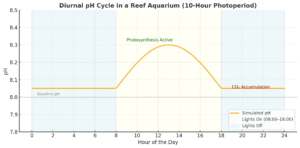
pH naturally fluctuates between day and night due to photosynthesis and respiration.
Alkalinity (KH)
Ideal range: 7–9 dKH
Stabilizes pH and provides carbonates for coral growth.
Calcium (Ca)
Ideal: 400–450 mg/L
Key element for coral skeletal growth.
Magnesium (Mg²⁺)
Ideal: 1250–1350 mg/L
Prevents calcium and carbonate precipitation, stabilizing the system.
Nutrients: Nitrates & Phosphates
Nitrate: 1–10 ppm
Phosphate: 0.02–0.08 ppm
Zero nutrients = starving corals. Balance is critical.
Balanced Ion Table (Ca–KH–Mg)
| Calcium (mg/L) | Alkalinity (dKH) | Magnesium (mg/L) |
|---|---|---|
| 380 | 6.5–7.5 | 1200–1250 |
| 420 | 7–8 | 1300 |
| 440 | 8–9 | 1350 |
| 460 | 9–10 | 1380–1400 |
Scientific Insights
⚛️ Ionic Balance
Calcium (Ca) and carbonate (CO₃) ions serve as the basic building blocks for coral skeletons. They come together under the correct conditions to form aragonite, which is the crystalline form of calcium carbonate (CaCO₃). Aragonite is used by corals to build and strengthen their structures. It is accomplished through biogenic calcification, which takes place in specialized tissues, and is under the influence of water chemistry surrounding them, mainly pH, as well as alkalinity. However, in an imbalanced environment, calcium and carbonate ions can spontaneously precipitate in the water column as unusable particulates, lessening the availability of these essential elements. It is in such situations where magnesium (Mg) comes into the picture. As the natural buffer, magnesium disrupts the uninhibited crystallisation of calcium carbonate through the prevention of lattice formation. While doing so, it retains calcium as well as carbonate ions in dissolved form with biological availability. Keeping the calcium, alkalinity, and magnesium in proper ionic balance with one another the so called “reef triad”, is critical, not only to the growth of the corals, but to the overall health of your reef system. When all three elements exist in harmony, they promote healthy calcification rates, stabilize the pH, and eliminate chemical imbalances that can otherwise stress or halt the growth of your corals.
🪸 Coral Calcification and pH
Coral calcification is the biological process in which reef building corals form their hard skeleton. It occurs as corals absorb active calcium (Ca) and carbonate (CO₃) ions from the surrounding water and use them to form aragonite, which is the crystalline form of calcium carbonate (CaCO₃). It is in these specialized cells in the tissues of the coral that the aragonite is deposited in thin layers, enabling the colony to gain in size and develop intricate skeletal structures. This is extremely water chemistry dependent—specifically PH. Seawater contains carbonate ions in equilibrium with bicarbonate and carbon dioxide. Under lower PH levels (more acidic waters), the concentration of carbonate ions falls, which makes it more difficult to obtain what corals require to build their skeletons. With the opposite, the consistent and slightly alkaline PH ranging from 8.3 to 8.4 offers enhanced availability of carbonates as well as calcification efficiency. PH in an aquarium is influenced by several factors including CO₂ buildup, light cycles, surface disturbance, and photosynthesis. During the daytime, photosynthetic processes carried out by zooxanthellae (the algae living in symbiosis within the tissue in corals) use CO₂, increasing the pH. Nighttime is the reverse, with CO₂ accumulation decreasing the PH. The natural daily cycle is to be expected, but too drastic fluctuations will stress corals and hinder calcification. In order to encourage healthy bone formation, one needs to ensure Adequate aeration, as well as surface Correct alkalinity (7–9 dKH) to balance pH A regulated photoperiod and balanced nutrient supply In essence, calcification in corals is not only about having the correct building blocks in the water, but also about the right conditions under which to utilize them. Stable pH is one of the greatest and little understood secret keys to long term health as well as growth in corals.
☀️ Light, Photosynthesis & pH
Not only does light beautify the appearance of the reef tank it also forms an integral part of the chemical dynamics within the system. Central to it is photosynthesis, which is carried out by the zooxanthellae: the small, symbiotic algae living in the tissues of the corals. It is with light energy that the algae convert CO₂ from carbonic acid in solution to oxygen and sugars, fueling their own metabolism and that of the host coral. During the light hours, photosynthesis removes CO₂ from the water with active uptake. As carbon dioxide is naturally carbonic acid in solution, removal thereof creates an increase in pH to make water ever so faintly alkaline. The adjustment is not only indicative of improved gas exchange but is also increasing the concentration of the ions of carbonates, which is essential to corals’ process of calcification. Under the night, photosynthesis is abolished and then resumed by corals as well as symbionts in the form of respiration. Respiration releases CO₂ back into the water, which is causing the concentration to accumulate as well as to lower the pH. Such daily fluctuations happen naturally in aquaria reefs, but in the event that theirs is excessive or unevenly regulated, sensitive corals, especially SPS species, will be put under stress. Suitable gas exchange as well as aeration must be provided in order to cushion the natural pH cycle. Skimmers, surface agitation, as well as open top boxes, allow the elimination of excessive CO₂ as well as stabilizing water chemistry. Maintaining the light schedule as well as keeping the biological balance in good shape helps to lower the risk of severe pH fluctuations. Ultimately, knowledge about the interrelation among light, photosynthesis, as well as pH equips the reefkeepers with an effective suite of tools: to stabilize the tank as well as to construct an environment in which corals as well as their microscopic friends will live in harmony.
Practical Tips: Improving Gas Exchange
- 💨Increase surface agitation using wavemakers, return pumps, or air stones to promote better oxygen and CO₂ exchange.
- 🌀Use a protein skimmer that actively injects air into the water, improving oxygenation and removing excess CO₂.
- 🔁Keep a portion of the tank or sump open to allow natural gas exchange with ambient air, especially in enclosed cabinets.
- 🌬️Ventilate the room where the aquarium is located—this reduces the risk of CO₂ accumulation in closed environments.
- 🧪Test indoor CO₂ levelsElevated CO₂ in your home or fish room can limit your tank’s pH ceiling, even with good equipment.
Suggested Testing Schedule
| Parameter | Recommended Frequency |
|---|---|
| Temperature | Daily (continuous monitoring preferred) |
| Salinity | Weekly |
| pH | 2–3 times per week (or continuously) |
| Alkalinity (KH) | 2–3 times per week |
| Calcium | Weekly |
| Magnesium | Weekly |
| Nitrates & Phosphates | Weekly |
| ICP-OES Test | Monthly or bimonthly |
In the world of reefkeeping, I have learned the importance of stability over perfection. It is no longer about reaching the “perfect” reading on the test kit, it is about creating a rhythmical breathing system with balance. Corals do not live optimally due to the fact that we read exactly 8.3 or exactly 420, it is when we maintain things in equilibrium with respect to their natural requirement. In time, you come to regard water chemistry as more than just data, but as the unseen language of your reef. When you grasp the way it all ties in how light impacts pH, the way magnesium secures calcium, the way corals react to small changes you cease to react, and begin to anticipate. That is where the magic begins. If you want to be consistent, learn from your system, and honor the science behind it, you won’t simply keep corals. You’ll build a living reef that pays you back in color, vitality, and wonder every single day.


About Author
