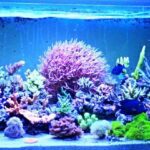
The moon that made corals spawn in London was built from five LEDs. In a closed aquarium at the Horniman Museum and Gardens, researchers calibrated that artificial moon to just 1 lux, measured 1 cm above the water surface at “full moon” [1]. Combined with a reef’s own temperature curve and its sunrise and sunset times, that faint glow was part of a recipe that pushed four Acropora species through their whole annual egg-and-sperm cycle and into coral spawning in a London aquarium. The authors describe it as the first time broadcast coral spawning had been induced in a fully closed artificial ex situ environment [1].
Coral spawning used to be something you could mostly witness only by diving on the right reef, on the right night. Here is how closed tanks now recreate it, and what that means for a home reef.
One Night a Year: What Coral Spawning Looks Like on a Real Reef
The modern mass coral spawning story starts in 1984, when a team on the Great Barrier Reef reported synchronous spawning in 32 coral species, a few nights after late-spring full moons in 1981 and 1982 [7]. In every species observed, gametes were released and fertilised outside the colony [7], challenging the then-common view that most corals brood their larvae.
Today the balance is clear: more than 80% of coral species with a known reproductive mode are broadcast spawners [11]; brooders, which release ready-made larvae, are the minority. Acropora like those in the studies below release egg-sperm bundles that break apart into individual eggs and sperm [11]; the buoyant eggs can gather at the surface [11], and in the London tanks the released gametes floated straight up [1].
So what triggers coral spawning on a given night? The literature points to stacked cues on different time scales:
- Season (which month): across 34 reefs and 99 Acropora species in the Indian and Pacific Oceans, the best predictor of the spawning month was a rapid rise in sea surface temperature, not the average temperature itself [8].
- Lunar phase (which night): mass spawning typically happens several days after a full moon, once a year [9].
- Time after sunset (which hour): the hour of release is closely linked to the daily light-dark cycle, and in aquaria it stayed in step with sunset [1].
The moonrise trick: why darkness after sunset matters
A 2021 study on the coral Dipsastraea speciosa in Taiwan gave the lunar cue a neat mechanism. After full moon, moonrise slips about 48 minutes later each night, which opens a dark gap between sunset and moonrise. The authors propose that this “period of darkness between sunset and moonrise that occurs after the full moon is a trigger for spawning” [9].
The numbers are striking. In the lab, four nights of dim light at only about 0.3 lux delayed the main spawning by 3 to 4 nights [9]. Dim light in the first half of the night (18:30-00:00) delayed coral spawning and made it less synchronised; the same light after midnight caused no delay [9]. Blue, green and red light all had a similar effect [9]. Release itself came around 21:00 to 22:00 [9].
Scope check: the moonrise result comes from one species at one site in Taiwan [9]. It fits what aquarium researchers saw, but it is not proven for every coral, including your Acropora.
Inside the Mesocosm: How Project Coral Recreated Two Reefs in London
The core study is Craggs et al. (2017) in Ecology and Evolution [1]. Jamie Craggs and colleagues built microprocessor-controlled mesocosms at the Horniman that copied the calendar of two real places: Kusu Reef in Singapore and Lizard Island on the Great Barrier Reef [1]. In simple terms, each system received its reef’s temperature through the year, day length, seasonal sunlight intensity and lunar cycle [1]. In more detail:
- Temperature: the Singapore profile came from a logger at 3-4 m depth (2011-2012); the GBR profile came from the Australian Institute of Marine Science 10-year average for Lizard Island [1]. Monthly temperature values were entered into the controller, which smoothed them into a daily set point for the heaters and chiller [1].
- Sunrise, sunset and day length: eight Radion XR30w Pro LED units hung 30 cm above the water, ramping up for 3 hours at sunrise and down for 3 hours at sunset [1].
- Seasonal sunlight: intensity was adjusted weekly from 22-year NASA insolation averages, between 60% output (378 μmol/m²/s) and 100% output (498 μmol/m²/s) [1]. See our PAR guide.
- Moonlight: a five-LED lunar module, calibrated to 1 lux 1 cm above the surface at full moon [1].
- Real darkness: blackout blinds were drawn 30 minutes before sunset [1].
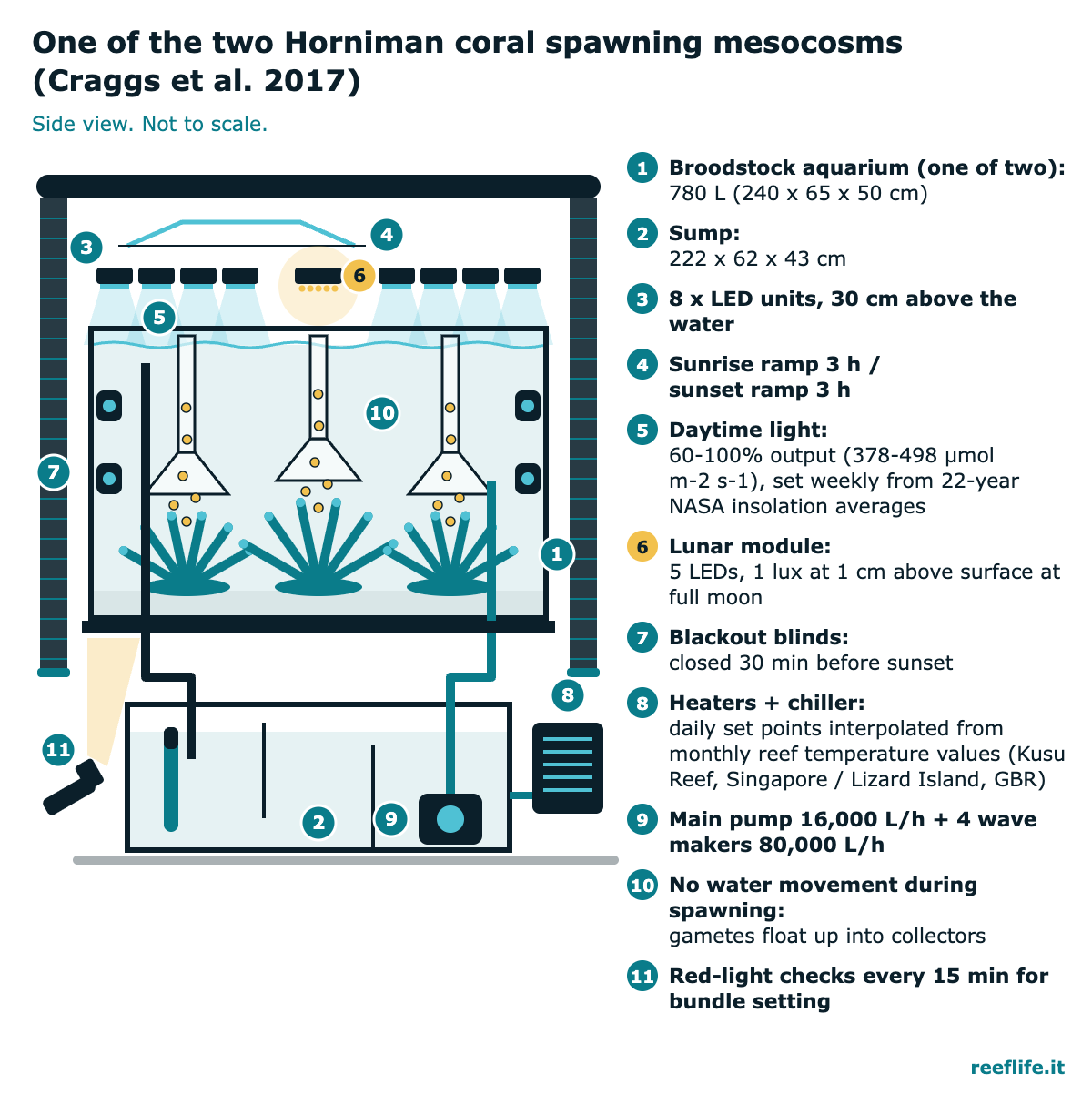
Each of the two broodstock tanks (one per reef profile) held 780 L (240 x 65 x 50 cm); carbon and GFO were replaced every 2 weeks and alkalinity was targeted at 7 dKH (2.5 meq/L) [1]. AVen’s view: nothing exotic, just a very well-run SPS system. For the stability side, our overview of essential water parameters in a reef aquarium covers the basics.
The Coral Spawning Results, in Numbers
Here is what the four species did. Times are the simulated local reef time of each system [1].
| Species (reef profile) | Colonies | Key result | Spawning onset (simulated local time) |
|---|---|---|---|
| Acropora hyacinthus (Singapore) | 14 | 2015: 10 colonies gravid on arrival spawned 10-13 April 2015. 2016: 4 colonies (28.57%) completed the full cycle in the tank [1] | 21:10-21:15, ending 21:35-21:42 (2016) [1] |
| A. millepora (GBR) | 5 | 2015: 5/5 gravid. 2016-17: 100% completed the cycle [1] | 21:06-21:49 [1] |
| A. tenuis (GBR) | 7 | 2015: 5/7 gravid. 2016-17: 57.14% completed the cycle [1] | 21:26-21:32 [1] |
| A. microclados (GBR) | 6 | 2015: 3/6 gravid. 2016-17: 100% completed the cycle [1] | 22:10-22:30 [1] |
The GBR colonies spawned on 2-7 December 2015, 6-11 nights after full moon; the next season, coral spawning in the GBR tank ran from November 2016 to January 2017, while the Singapore A. hyacinthus spawned in late March-early April 2016 [1].
Two results deserve attention. First, the hour was right: release times after sunset for A. hyacinthus, A. millepora and A. tenuis were consistent with time windows described in the wild [1]. Second, the night was off: “Spawn date in relation to full moon, however, was delayed in all species, possibly as a result of external light pollution” [1]. Some colonies spawned up to nine nights late [1]. Next to the Taiwanese result, where 0.3 lux shifted spawning by several nights [9], stray light looks anything but trivial.
A companion paper showed that 14 A. hyacinthus colonies shipped about 34 hours to London still spawned within 3-4 nights of wild colonies when gravid at collection [2].
A Second Proof: Pillar Coral Spawning Within Minutes of the Wild
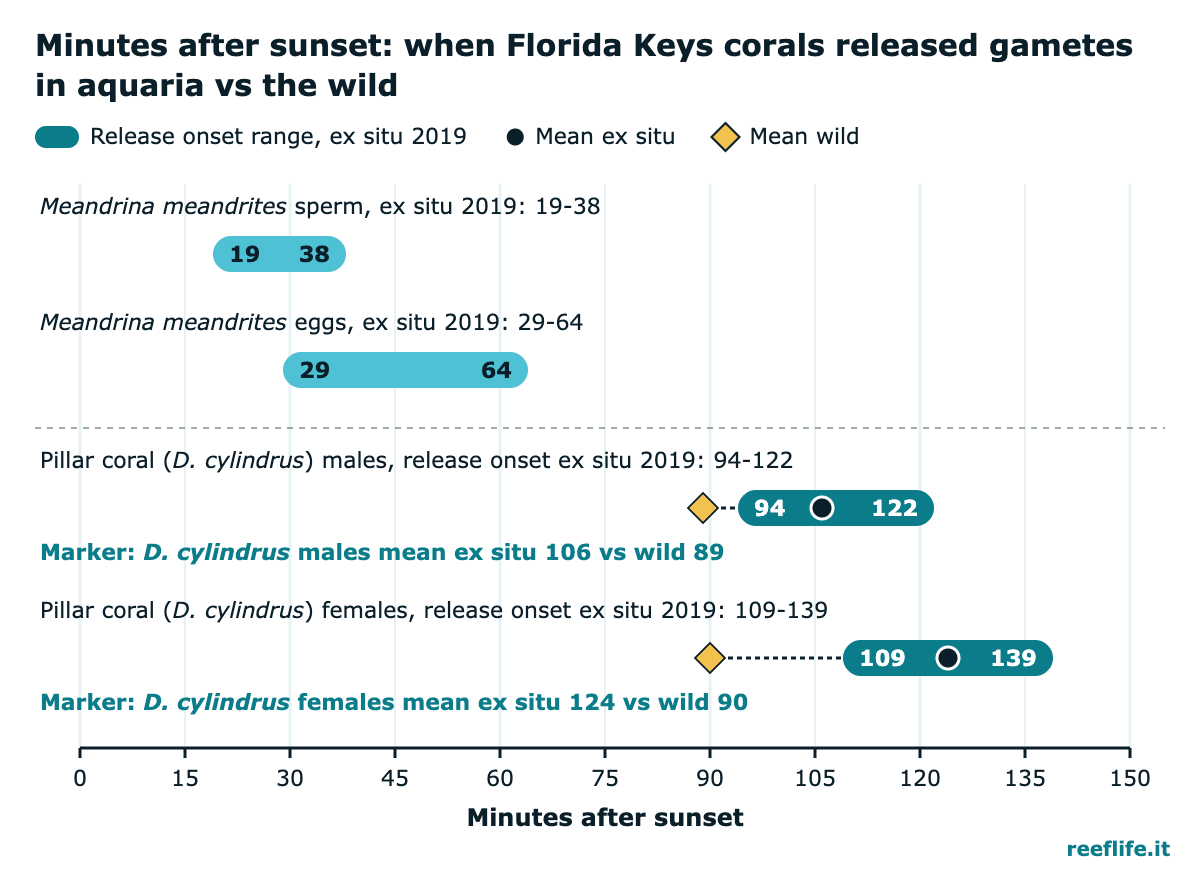
At The Florida Aquarium, a team including Craggs programmed lighting and temperature to mimic Key Largo for two highly disease-susceptible corals, the pillar coral Dendrogyra cylindrus and Meandrina meandrites, through 2019 and 2020 [6].
In 2019 the pillar corals spawned on 17-19 August, 2-4 nights after full moon. Males began releasing sperm 94-122 minutes after sunset and females began releasing eggs 109-139 minutes after sunset [6]. That is close to the wild, though slightly late: about 17 minutes later for males (106 vs 89 minutes after sunset) and 34 minutes later for females (124 vs 90) [6]. In 2020, more than 50,000 viable D. cylindrus larvae were produced from only a fraction of the collected spawn [6]. Most parent colonies are no longer alive in the wild [6], so these tanks work like a genetic lifeboat.
After the Bundles Rise: Fertilisation, Larvae and Settlement
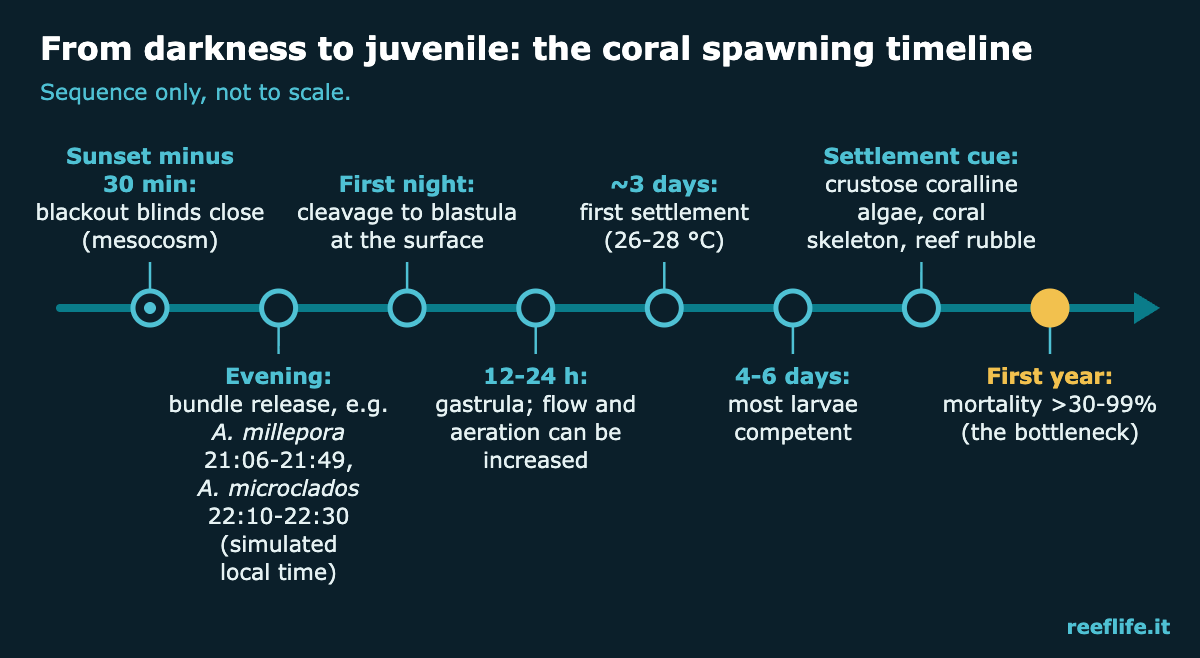
Coral spawning is only the opening scene. At the Horniman, colonies were checked with red-light torches every 15 minutes for “bundle setting”; with no water movement, gametes floated straight into collectors for controlled in vitro crosses [1]. From there, according to a major restoration review [11]:
- The first night: early embryo development, from first cleavage to blastula, usually happens overnight at the surface [11].
- 12-24 hours: embryos reach the gastrula stage, after which aeration and flow can be increased [11].
- About 3 days: first settlement is typically seen at 26-28 °C, with most larvae competent within 4-6 days [11].
- Settlement: larvae need a cue. Chemical cues from crustose coralline algae (CCA) and microbial biofilms are considered more influential than physical cues in triggering settlement in many species [11]. In a classic experiment with Acropora millepora larvae, four CCA species triggered metamorphosis, and so did coral skeleton and calcified reef rubble [10].
- The first year: this is the real bottleneck. Mortality in the first year after settlement “can be extremely high (>30-99%)” [11].
New to the coral-algae partnership? See our explainer on zooxanthellae.
Closing the loop: corals born in a tank, spawning in a tank
A follow-up paper reported completing the life cycle of a broadcast spawning coral in a closed mesocosm [3], and Craggs’ thesis describes the first F2 generation of A. millepora raised in a fully closed aquarium [4]. A. millepora spawned at the Horniman in 2017 had reached sexual maturity by the 2020/21 season and produced a new generation [5]. The thesis also found that survival improved when settlement groups contained more than two genotypes, and when juveniles were co-cultured with higher densities of the tuxedo urchin Mespilia globulus, a grazer [4].
Why Ex Situ Coral Spawning Matters Beyond the Lab
Current restoration relies predominantly on asexually produced fragments [11], which copy existing genotypes. Collecting gametes and larvae while leaving adults on the reef is considered more ecologically sustainable [11].
Ex situ spawning adds three advantages:
- Access far from reefs: the system could broaden the number of institutions worldwide able to work with broadcast spawning corals [1].
- Timing on demand: by shifting artificial calendars, the authors foresee “the possibility of year-round broadcast reproductive events” [1].
- Genetic rescue: pillar coral parent fragments collected across more than 230 km of reef, most now gone from the wild, still contributed gametes in tanks [6].
Not every coral needs such an elaborate calendar. A 2026 paper on lab methods reports that the temperate coral Astrangia poculata can be reliably induced to spawn by a warming treatment: colonies held at 19 °C were warmed to room temperature or given seawater heated to 27-28 °C, and fertilisation success typically ranged from 70% to 93% [12]. Do not try it on an Acropora.
Coral Spawning in a Home Aquarium: What You Can Realistically Do
Can a hobbyist see coral spawning at home? As Dr. Nikki Fogarty is quoted in CORAL Magazine: “It doesn’t take a Ph.D. to spawn corals in tanks” [14]. True, but the Horniman needed a reef-specific temperature curve, sunrise and sunset ramps, a calibrated moon and blackout blinds [1]. AVen’s view: most home tanks run a flat temperature and a fixed daily light schedule, the opposite of a seasonal calendar. Planned coral spawning is a project, not a happy accident.
If the idea tempts you, here are scoped, low-risk steps:
- Log before you tweak. Record temperature, photoperiod, moonlight and odd night-time events; unlogged, a coral spawning event looks like random cloudy water.
- Think in slow seasons, not spikes. The reef signal is a rapid seasonal rise in temperature between months [8], and the Horniman turned monthly values into a smooth daily temperature curve [1]; sudden jumps are not the lesson.
- Respect real darkness. Spawning dates in London slipped, possibly due to light pollution [1], and 0.3 lux shifted spawning in Taiwan [9]. A TV, a hallway light or a bright moonlight LED may matter more than you think.
- Do not copy the flow trick blindly. The mesocosm had no water movement during spawning [1]. In my opinion that is a research step, not husbandry; for why flow matters, see our coral boundary layer guide.
If a coral spawns in your tank tonight
Gametes in a closed system can turn from wonder into pollution. In the London study one A. tenuis colony developed white syndrome and did not spawn, and the authors suggest that isolating its tank from the filtration around spawning time may have lowered oxygen levels [1]. The clearest hobby advice I found is written for giant clam spawning, not corals, but the problem is similar: dying gametes can drop oxygen, raise ammonia and nutrients, and fuel algae [13]. That source recommends [13]:
- increasing aeration and surface agitation;
- siphoning gametes out where practical;
- a water change of around 25%, then reassessing;
- testing ammonia and cleaning any mechanical filter media that caught gametes.
AVen’s note: that source only mentions in passing that mechanical filtration and a skimmer would remove gametes, and it gives carbon no clean-up role [13]; a large water change and oxygen are the sourced first moves.
What to Take Away From the London Spawning Nights
- Coral spawning follows layered cues: a rapid seasonal temperature rise sets the month [8], the lunar cycle the night (in one Taiwanese coral, via the dark gap between sunset and moonrise) [9], and the daily light cycle the hour [1].
- Copying those cues made four Acropora species spawn in a closed aquarium [1]; pillar coral released gametes on average only about 17-34 minutes later than wild colonies [6].
- Stray light is a possible weak spot: it possibly delayed spawning in London [1] and shifted spawning in a lab study [9].
- The hardest part comes after spawning: first-year mortality can be extremely high, from more than 30% up to 99% [11], and in Craggs’ thesis experiments on Acropora juveniles, survival improved with more than two genotypes per settlement group and with more grazing urchins [4].
- At home, log first, change slowly, keep nights dark, and treat any spawning event as a water-quality event [13].
References
- Craggs J, Guest JR, Davis M, Simmons J, Dashti E, Sweet M (2017). Inducing broadcast coral spawning ex situ: Closed system mesocosm design and husbandry protocol. Ecology and Evolution 7(24): 11066-11078. https://doi.org/10.1002/ece3.3538
- Craggs JRK, Guest JR, Brett A, Davis M, Sweet M (2018). Maintaining natural spawning timing in Acropora corals following long distance inter-continental transportation. Journal of Zoo and Aquarium Research 6(2): 30-36. University of Derby repository (PDF)
- Craggs J, Guest J, Davis M, Sweet M (2020). Completing the life cycle of a broadcast spawning coral in a closed mesocosm. Invertebrate Reproduction & Development 64(3): 244-247. https://doi.org/10.1080/07924259.2020.1759704
- Craggs J (2020). Developing protocols and methods to predictably induce ex situ broadcast coral spawning and increase post settlement survivorship. PhD thesis, University of Derby. University of Derby repository
- Horniman Museum and Gardens (2021). Coral spawning season at the Horniman Aquarium. horniman.ac.uk
- O’Neil KL, Serafin RM, Patterson JT, Craggs JRK (2021). Repeated ex situ spawning in two highly disease susceptible corals in the family Meandrinidae. Frontiers in Marine Science 8: 669976. https://doi.org/10.3389/fmars.2021.669976
- Harrison PL, Babcock RC, Bull GD, Oliver JK, Wallace CC, Willis BL (1984). Mass spawning in tropical reef corals. Science 223(4641): 1186-1189. https://doi.org/10.1126/science.223.4641.1186
- Keith SA, Maynard JA, Edwards AJ, et al. (2016). Coral mass spawning predicted by rapid seasonal rise in ocean temperature. Proceedings of the Royal Society B 283(1830): 20160011. https://doi.org/10.1098/rspb.2016.0011
- Lin C-H, Takahashi S, Mulla AJ, Nozawa Y (2021). Moonrise timing is key for synchronized spawning in coral Dipsastraea speciosa. PNAS 118(34): e2101985118. https://doi.org/10.1073/pnas.2101985118
- Heyward AJ, Negri AP (1999). Natural inducers for coral larval metamorphosis. Coral Reefs 18: 273-279. https://doi.org/10.1007/s003380050193
- Randall CJ, Negri AP, Quigley KM, et al. (2020). Sexual production of corals for reef restoration in the Anthropocene. Marine Ecology Progress Series 635: 203-232. https://doi.org/10.3354/meps13206
- Borbee EM, Changsut I, McAlister JS, et al. (2026). Development of methods for spawning, fertilization, larval husbandry, and settlement in the temperate coral Astrangia poculata. Frontiers in Marine Science 13. https://doi.org/10.3389/fmars.2026.1901305
- Reefs.com (2009). Aquarium Invertebrates: A Look at Giant Clam Spawning in Aquaria. reefs.com
- Lawrence J (2021). CORAL Excerpt: Dawn of a New Era for Marine Aquarists? CORAL Magazine. coralmagazine.com
About the author: AVen (Alessandro) keeps an SPS-dominated reef aquarium and writes ReefLife to translate reef science into practical, honest advice for home aquarists. Read more about AVen and ReefLife.