Every Acropora branch, every brain-coral ridge and every pink crust of coralline algae in your tank is made of calcium carbonate that the water gave up. When you run a KH test, you are not checking some abstract “water quality” number: you are measuring the raw material your corals are eating. That is what alkalinity really is for a reefkeeper, and the speed at which it falls between doses is one of the best growth meters you have.
This article explains the chemistry in plain terms first, then looks at what happens inside a coral, why your KH drops, what range to keep, and how to adjust it without hurting anything.
What alkalinity is, in one minute
Chemists define total alkalinity as the excess of proton acceptors (bases) over proton donors (acids) in a water sample [2]. In practice it is the water’s acid-neutralising capacity: how much acid (H+) you must add to drive the pH down to a fixed end point [1]. Your test kit does exactly this. It is a small titration, and the colour change marks the end point [1].
In seawater almost all of that capacity comes from two ions. At pH 8, Holmes-Farley (citing Millero) gives bicarbonate (HCO3-) as about 89.8% of the total, carbonate (CO3 2-) about 6.7%, borate about 2.9%, and silicate, magnesium monohydroxide, hydroxide and phosphate the small remainder [1]. So for a reef tank, KH is a good stand-in for “how much bicarbonate and carbonate is available”.
The carbonate system: CO2, bicarbonate, carbonate
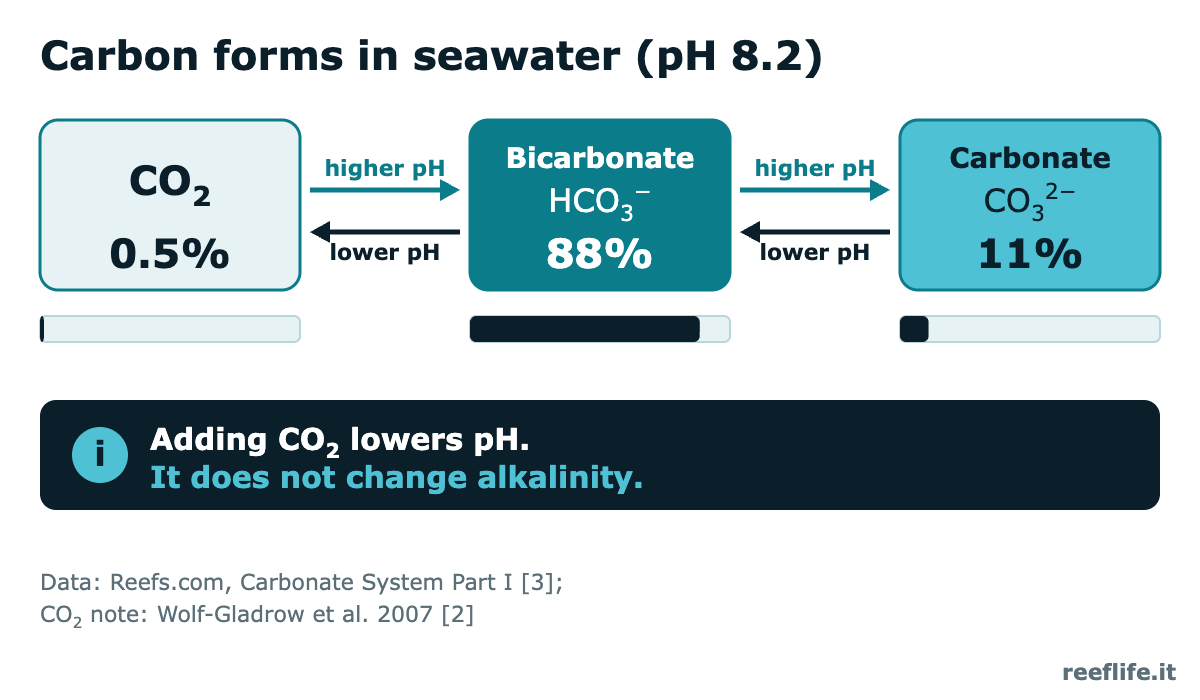
Dissolved CO2, bicarbonate and carbonate are three forms of the same inorganic carbon, and they convert into one another as pH changes. At a normal seawater pH of 8.2, total inorganic carbon is about 88.4% bicarbonate, 11.0% carbonate and only about 0.54% dissolved CO2 [3]. When seawater absorbs more CO2, the pH falls [12], but total alkalinity does not change when CO2 enters or leaves the water [2]. That distinction will matter in the myths section.
Units: dKH, meq/L and ppm
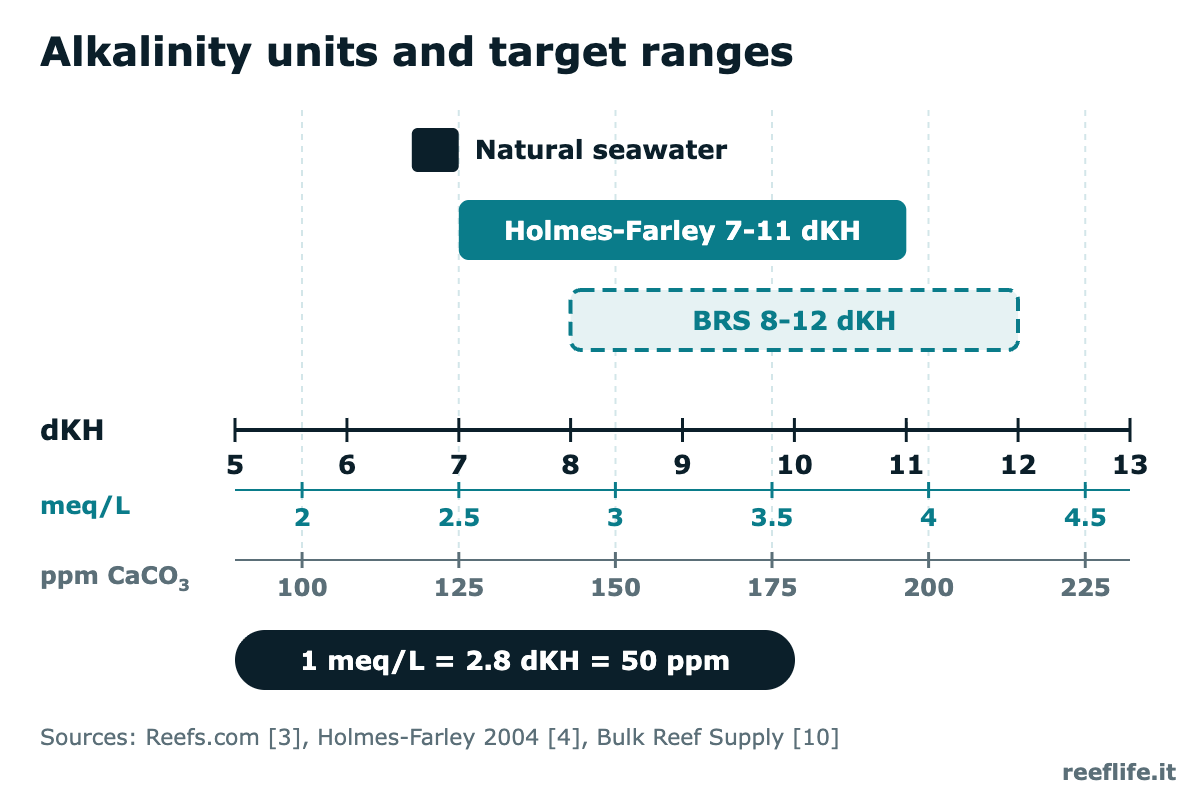
Hobby kits usually read in dKH; scientists use meq/L (or µmol/kg). The conversions are simple [3]:
- meq/L × 2.8 = dKH
- meq/L × 50 = ppm as CaCO3
- dKH × 17.9 = ppm as CaCO3
Holmes-Farley gives the same rule for kits: divide dKH by 2.8 to get meq/L [1].
How corals turn carbonate into skeleton
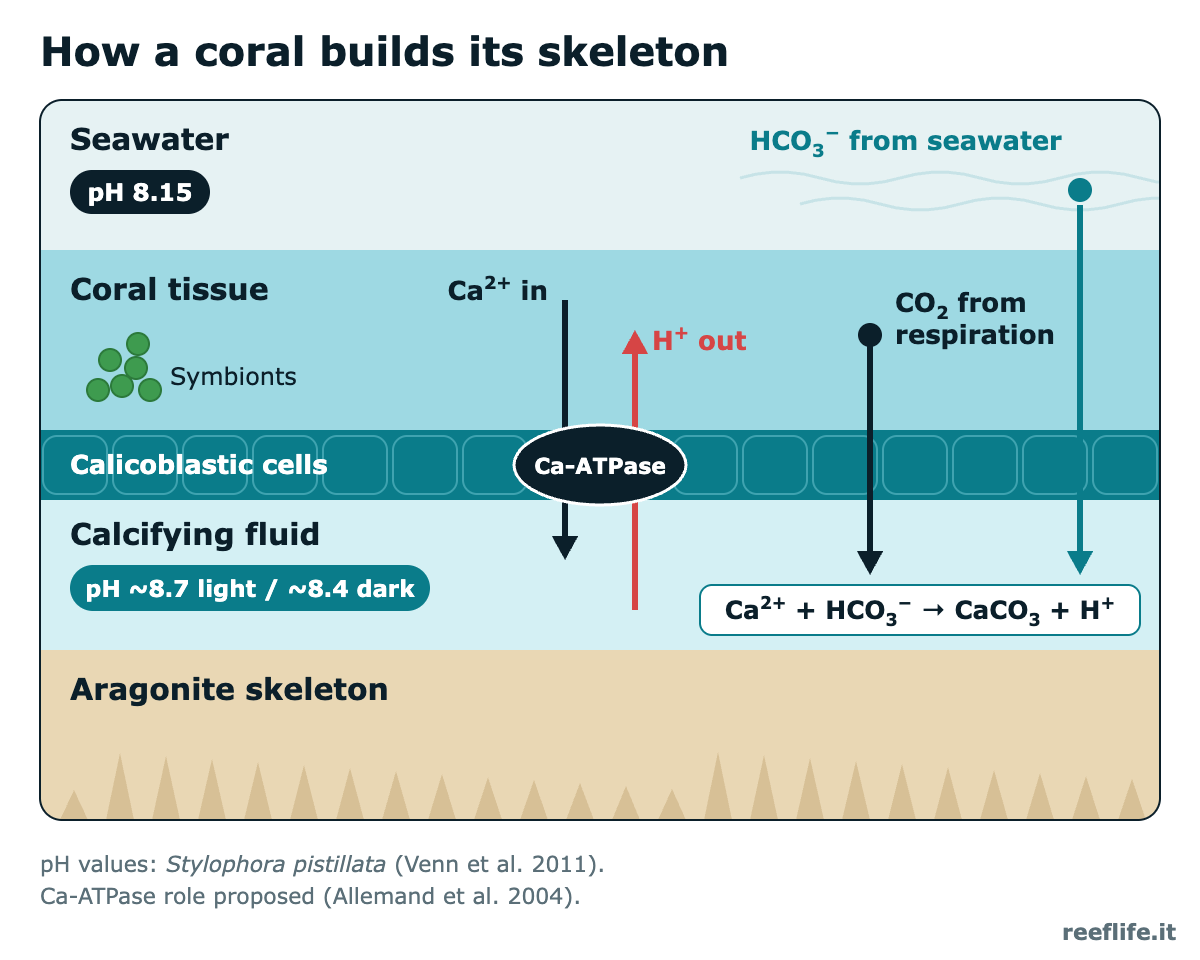
The simple version: a coral builds its skeleton in a tiny, semi-isolated space between its tissue and the existing skeleton. It pumps calcium into that space, removes acid from it, and so creates conditions where aragonite (the mineral form of coral skeleton) precipitates far more easily than in open seawater.
The calcifying space
The tissue layer that touches the skeleton is the calicoblastic epithelium, a flat layer 0.5 to 3 µm thick that is responsible for forming the aragonite skeleton [5]. Under it lies a thin fluid layer, the subcalicoblastic medium or calcifying fluid, where the skeleton grows in what Allemand and colleagues call a “biologically-controlled medium” [5].
Pumping calcium in and protons out
Precipitating carbonate from bicarbonate releases a proton (Ca2+ + HCO3- -> CaCO3 + H+) [5]. That acid has to be removed for calcification to continue [5]. The review by Allemand et al. discusses the hypothesis that a Ca2+-ATPase, working as a Ca2+/H+ exchanger with a probable 1:1 stoichiometry, moves calcium into the calcifying space and removes the protons produced by precipitation; preliminary results place this enzyme in the calicoblastic cells [5]. Carbonic anhydrase, the enzyme that speeds up CO2/bicarbonate conversion, has been located in the calicoblastic epithelium, and in one study on Stylophora pistillata cited in the review, a carbonic anhydrase inhibitor (ethoxyzolamide) cut calcification by 80% [5].
The result is measurable. Using live-tissue imaging in Stylophora pistillata, Venn et al. found the pH of the calcifying fluid about 0.5 units above seawater in the light (about 8.7 versus 8.15) and about 0.2 units above it in the dark (about 8.4) [6]. Their model estimate of aragonite saturation in that fluid was roughly 20 in the light and 11 in the dark [6]. The authors present proton removal by a Ca2+-ATPase as a proposed explanation, not a proven one [6]. Keep in mind these figures come from one species.
Where the carbon comes from
The skeleton’s carbon has two sources: metabolic CO2 from the coral’s own respiration and bicarbonate taken up from seawater [5]. In work reviewed by Allemand et al., about 60-70% of skeletal carbon may come from respired CO2 [5]. That might seem to suggest corals do not need your bicarbonate, but the tank’s chemistry still pays the bill. In a closed system, precipitating 1 mole of CaCO3 always lowers dissolved inorganic carbon by 1 mole and total alkalinity (TA) by 2 moles [2]. Carbon can come back in as CO2, but CO2 does not restore TA [2].
Light and calcification
Allemand et al. note that in light-dependent calcifiers, reef-building corals among them, calcification is faster in the light than in the dark, with a mean stimulation of around 3 times according to an earlier review they cite [5]. The mechanism is still debated, so treat it as an observation rather than a rule for your tank.
The fixed ratio between alkalinity and calcium
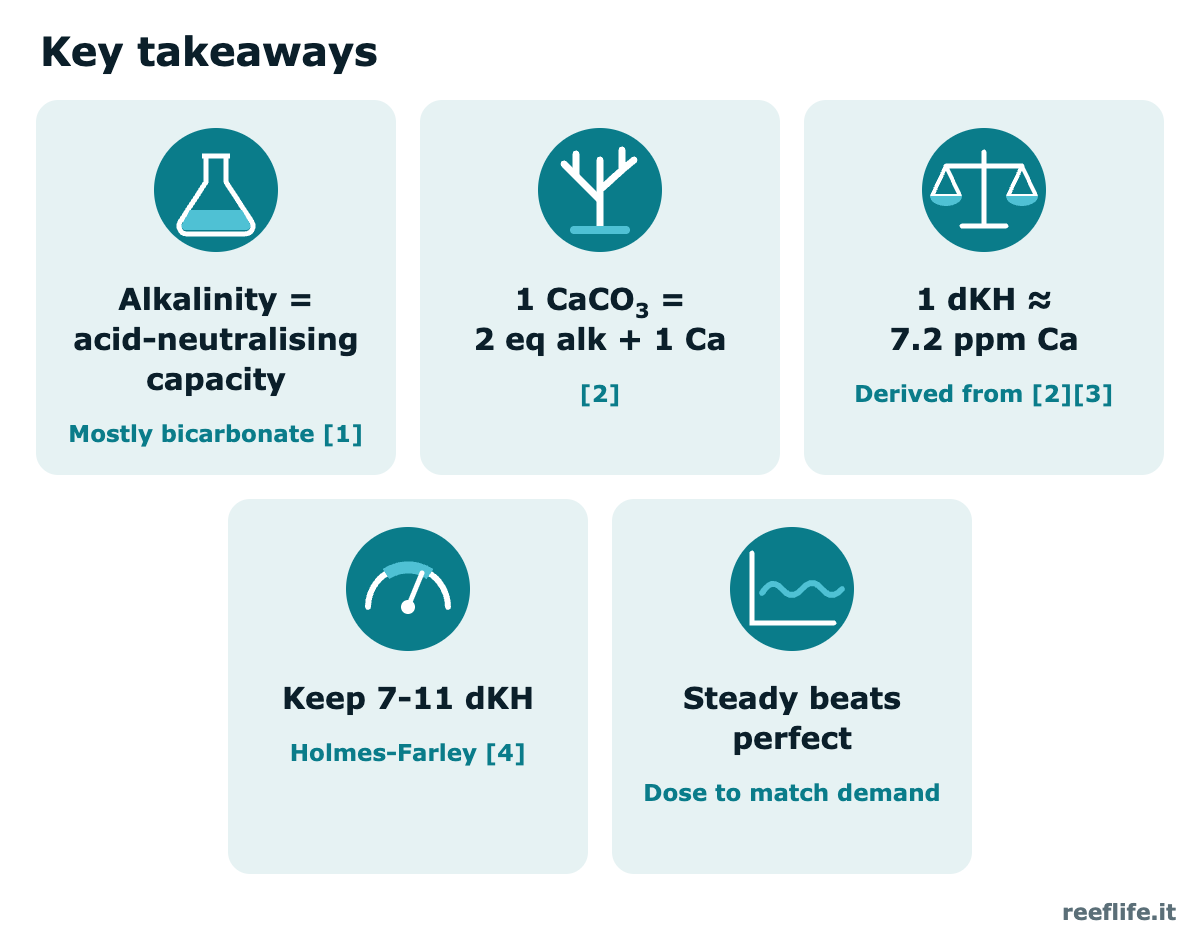
Because each mole of CaCO3 removes 1 mole of calcium and 2 equivalents of alkalinity [2], the two fall together in a fixed ratio. Working through the numbers: 1 dKH is 0.357 meq/L, which corresponds to 0.179 mmol/L of CaCO3, or about 7.2 mg/L (ppm) of calcium (using 40.08 g/mol for Ca). Put another way, a KH drop of 1 meq/L goes with a drop of about 20 ppm calcium [9]. That is why balanced supplements exist, and why the calcium, alkalinity and magnesium triad is always discussed together.
Why reef tank alkalinity drops (and what else moves it)
There are five main drivers that move reef tank alkalinity, some down and some up:
- Calcification by corals. In a tank without supplementation, KH drops quickly as corals use up what seawater contains [4].
- Other calcifiers. Coralline algae also build skeletons from the water’s ions [4].
- Abiotic precipitation. Alkalinity above natural levels can drive non-biological precipitation of calcium carbonate on heaters and pump impellers, which wastes both calcium and alkalinity [4].
- Nitrogen cycling. Nitrification (ammonium to nitrate) lowers TA by 2 moles per mole of nitrogen [2]. Denitrification gives back 1 mole per mole of nitrate [2], and algae taking up nitrate also raise it slightly [2].
- Water changes, salinity and dosing. TA changes with salinity [2], so evaporation raises your reading and overfilling with fresh water lowers it. That is one more reason to keep salinity steady (see why salinity matters). New salt water moves KH toward whatever your salt mix contains, and your supplements push it up.
What dKH should you keep?
Natural seawater
Surface seawater sits at roughly 2.35-2.5 meq/L. One reference gives an Atlantic average of 2.35 meq/L (6.58 dKH), normalised to salinity 35 [3]. Holmes-Farley’s table uses a typical 2.5 meq/L (7 dKH, 125 ppm) [4].
Common hobby targets
Holmes-Farley suggests keeping alkalinity between about 2.5 and 4 meq/L (7-11 dKH, 125-200 ppm CaCO3 equivalents), and calcium between about 380 and 450 ppm [4]. Bulk Reef Supply recommends 8-12 dKH [10]. Higher levels are acceptable as long as they do not drag calcium down through precipitation [4]. For the full picture of other parameters, see essential water parameters in a reef aquarium.
Why stability matters more than the exact number
Any value inside the range above can grow corals. What causes trouble in practice is sudden change. Reef Chasers, a coral retailer, writes that daily swings over 10% can stress corals and aims to keep them under 5% [11], which works out to about 0.4 dKH at 8.5 dKH. I could not find a controlled study that measures the harm from KH swings, so treat this as experienced hobby guidance, not lab-proven limits. The same applies to the widely shared forum view that high KH combined with very low nutrients causes SPS “tip burn”. It is a common hobby observation that I could not verify, so I have not presented it as fact.
What this means for your tank
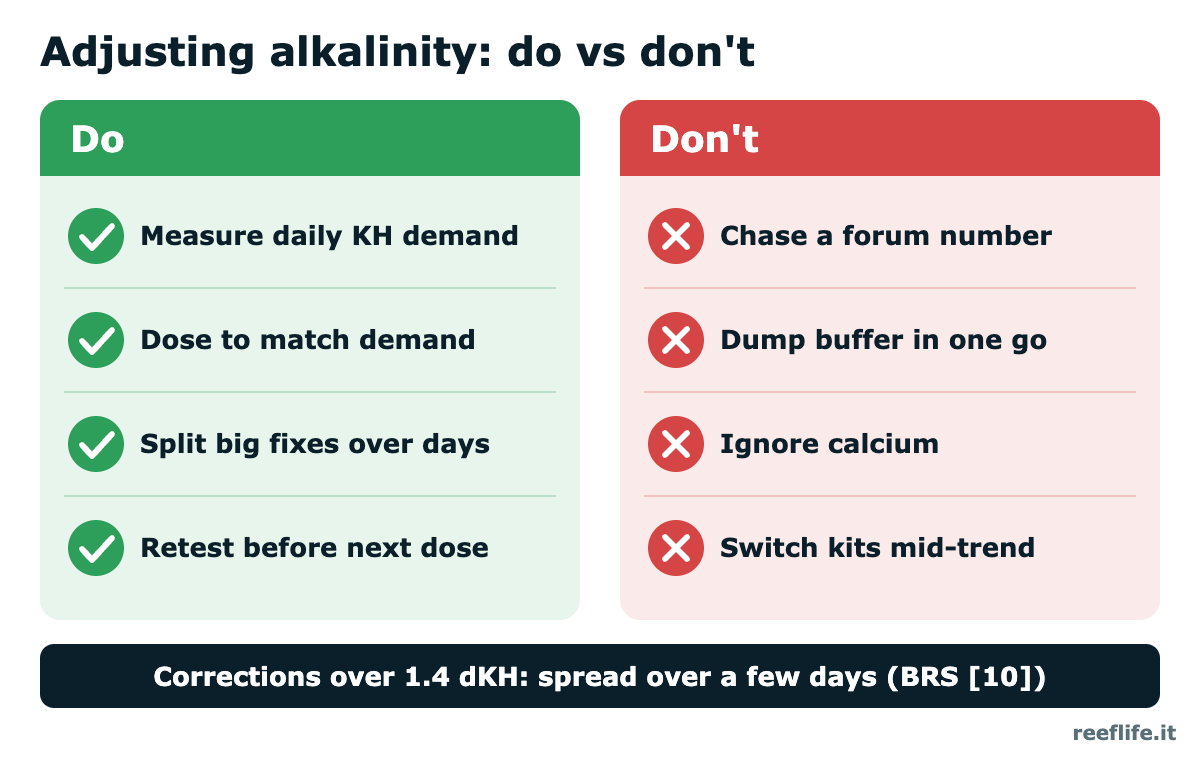
1. Measure consumption, not just level. Test KH at the same time of day for a week without changing your dosing. Your tank’s daily demand is the average daily drop, in dKH per day, plus whatever your current dosing adds each day. If KH holds steady, your dosing already matches demand. When demand rises over the months, your corals are growing.
2. Dose to match demand. The goal is to replace each day what corals consumed that day. Balanced methods include two-part additives, limewater (kalkwasser) and calcium carbonate/CO2 reactors [4]:
- Two-part / Balling: separate calcium and carbonate/bicarbonate solutions, ideally through a dosing pump. See the Balling method guide.
- Kalkwasser: settled limewater supplies calcium and KH together, but it is low in magnesium, so check Mg now and then [4].
- Calcium reactor: suits tanks with high demand. See our calcium reactor article.
3. Raise it gradually. Bulk Reef Supply advises splitting any correction larger than 1.4 dKH over a few days and testing between doses [10]. Baking soda or washing soda work for quick corrections [4], but add them slowly to a high-flow area. Never dump a whole correction at once, and stop and retest before the next dose.
4. Test well. Use the same kit, fresh reagents and good light. Holmes-Farley notes that some kit dye mixes may under-read by up to about 10% [1], so consistency matters more than chasing a decimal.
5. Watch calcium alongside. If KH keeps dropping while calcium stays flat (or the reverse), suspect the other drivers above, such as nitrification or precipitation, before blindly increasing the dose.
Myths about alkalinity
“Higher KH always means faster growth.” In one aquarium experiment, adding 2 mM bicarbonate doubled skeletal growth in Porites porites [7]. That is one species under lab conditions, not a guarantee for your SPS. Elevated KH also raises the risk of abiotic precipitation, which strips calcium and coats equipment [4].
“pH and alkalinity are the same thing.” They are related but different. Adding or removing CO2 changes pH without changing total alkalinity [2]. In a seawater model, doubling CO2 lowers pH by about 0.3 units while alkalinity stays unchanged [8].
“Copy the number from a forum.” Your target should sit in a reasonable range [4] and stay steady. A number that works in someone else’s tank depends on their salt, nutrients, lighting and livestock.
FAQ
Why does my KH drop so fast?
Usually because your corals and coralline algae are calcifying [4]. Nitrification [2] and precipitation on equipment [4] add to the loss. A faster drop over time usually means a growing reef, so increase dosing to match it.
Is 7 dKH too low?
No. It is close to natural seawater [3][4] and sits at the low end of the common 7-11 dKH hobby range [4]. Just keep it stable.
How much can I raise KH in one day?
Be conservative. Bulk Reef Supply advises spreading corrections larger than 1.4 dKH over a few days [10]. Test between doses.
Do I need to test calcium if I dose a balanced two-part?
Yes. Calcium and alkalinity are consumed in a fixed ratio [2][9], but other processes, such as nitrification, change KH on their own [2], so the two can drift apart.
Summary
Alkalinity is your water’s acid-neutralising capacity, made up mostly of bicarbonate and carbonate [1][3]. Corals build aragonite in a pH-raised fluid under their tissue [5][6], and every mole of CaCO3 they lay down costs the tank 2 equivalents of alkalinity and 1 mole of calcium [2]. Keep KH steady somewhere around 7-11 dKH [4], measure how fast it falls, dose to match that demand, and correct slowly.
References
- Holmes-Farley, R. (2002). Chemistry and the Aquarium: What is Alkalinity? Advanced Aquarist. https://www.advancedaquarist.com/2002/2/chemistry
- Wolf-Gladrow, D. A., Zeebe, R. E., Klaas, C., Körtzinger, A., & Dickson, A. G. (2007). Total alkalinity: The explicit conservative expression and its application to biogeochemical processes. Marine Chemistry, 106(1-2), 287-300. https://doi.org/10.1016/j.marchem.2007.01.006 (PDF: https://www.soest.hawaii.edu/oceanography/faculty/zeebe_files/Publications/WolfGladrowMarChem07.pdf)
- Aquarium Chemistry: The Carbonate System in the Aquarium, and the Ocean, Part I: The Components of the Carbonate System (2008). Reefs.com. https://reefs.com/?p=208965
- Holmes-Farley, R. (2004). Reef Aquarium Water Parameters. Reefkeeping Magazine. http://reefkeeping.com/issues/2004-05/rhf/index.php
- Allemand, D., Ferrier-Pagès, C., Furla, P., Houlbrèque, F., Puverel, S., Reynaud, S., Tambutté, É., Tambutté, S., & Zoccola, D. (2004). Biomineralisation in reef-building corals: from molecular mechanisms to environmental control. Comptes Rendus Palevol, 3(6-7), 453-467. https://doi.org/10.1016/j.crpv.2004.07.011
- Venn, A., Tambutté, E., Holcomb, M., Allemand, D., & Tambutté, S. (2011). Live tissue imaging shows reef corals elevate pH under their calcifying tissue relative to seawater. PLoS ONE, 6(5), e20013. https://doi.org/10.1371/journal.pone.0020013
- Marubini, F., & Thake, B. (1999). Bicarbonate addition promotes coral growth. Limnology and Oceanography, 44(3), 716-720. https://doi.org/10.4319/lo.1999.44.3.0716
- Chemistry and the Aquarium: The Relationship Between Alkalinity and pH (2002). Reefs.com. https://reefs.com/?p=208553
- Article on calcium and alkalinity maintenance (republished; title and author not shown on the page). Reefs.com. https://reefs.com/?p=209099
- Bulk Reef Supply. Alkalinity Calculator (Reef). https://www.bulkreefsupply.com/aquarium-calculators/alkalinity-calculator-reef
- Nair, S. (2022). Alkalinity, Calcium and Your Reef Tank. Reef Chasers. https://reefchasers.com/blogs/reef-tank-care-guides/alkalinity-calcium-and-your-reef-tank
- NOAA Pacific Marine Environmental Laboratory. What is Ocean Acidification? https://pmel.noaa.gov/co2/story/What+is+Ocean+Acidification%3F
About the author: AVen writes Reef Life, a blog about keeping and understanding reef aquariums. More about Reef Life


About Author
