This mistake involved the use of live feeds consisting of freshly hatched live Artemia provided multiple times a day and the assumption that “live” equates to “complete.”
This assumption is correct from a certain point of view because the live feeds will eat, thrive, and show some growth. This is a form of partial success because the live feeds will indeed survive but not reach their biological potential. Subtle but important problems will arise in the process.
What was not understood in the past but is understood today is that the use of freshly hatched live Artemia is nutritionally incomplete or deficient in terms of the levels of important fatty acids such as docosahexaenoic acid (DHA) and other highly unsaturated fatty acids (HUFA), as well as important vitamins. These fatty acids and vitamins are not optional nutrients but the building blocks for the development of the nervous systems, cell membranes, sensory systems, and neuromuscular systems of the marine fish fry.
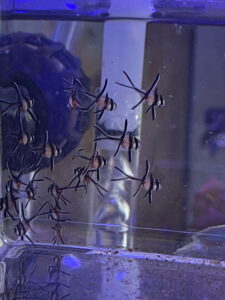
If the Banggai cardinalfish fry is reared solely on non-enriched live Artemia, the first sign of the deficiency is not necessarily the death of the fish but the weakness of the development. Some of the obvious manifestations of the weakness in development will be the lack of precision in swimming, the lack of stability in hovering in the water column, the lack of precision in the strike for prey, the lack of rapidity in the response to prey, and the lack of balance in the water column.
This is due to the fact that DHA is a major constituent of the cells of the nervous systems and the retina. Inadequate levels of DHA and the associated fatty acids and vitamins will impede the development of the nervous and visual systems.
Practically, the fry may display:
- irregular or “trembling” patterns of swimming;
- reduced ability to target and strike prey;
- reduced stamina between feedings;
- abnormal posture and drifting;
- increasing lethargy despite the appearance of being well-fed.
If the condition continues, death occurs, and the reason is not the lack of food, per se, but the fact that the nutritional value of the food is structurally deficient. This is important to note, as the individual cannot compensate for the lack of these nutrients and fatty acids. Neural membranes, neurotransmission, and sensory function rely on these nutrients and fatty acids during these early developmental windows. Once the developmental window has passed, the individual cannot recover.
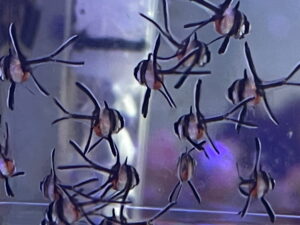
This background provides the context for the turning point in the successful rearing of Banggai fry: the transition from the simple provision of live Artemia to the enrichment of Artemia with phytoplankton, DHA/HUFA emulsions, and vitamins.
The transition from simply feeding the fish to actually “engineering live food” is the key to better growth rates and survival rates. The Banggai cardinalfish possesses a biological advantage over many other marine species in the sense that they are spawned as juveniles that can strike prey immediately upon release into the wild. This biological advantage translates into the need for the fry to have a rapid metabolism and constant energy input. This is not satisfied by simply feeding the live artemia, which is nutritionally empty. Enriching the live artemia is shown to bring about marked improvements in growth rates, mass, stress resistance, and survival rates. My pragmatic approach is based on a three-tiered approach to feeding the fry.
The first tier is the production of the prey (Artemia nauplii). The second tier is the feeding of the prey (phytoplankton pre-enrichment). The third tier is the enrichment of the prey (DHA/HUFA and Vitamins). Only after these tiers is the nauplii ready for use. This approach is similar to the approach taken in the aquaculture industry wherein unenriched zooplankton is not used for serious rearing.
Practically, I stress observation rather than timing. The colors of the water during the phytoplankton phase, density of swimming, nauplii activity, and surface films during DHA enrichment are all factors to consider. If the water is too dark green, I dilute the mixture. If nauplii are slowing in their enrichment, I reduce their enrichment time. It’s imperative that readers grasp that while the method is scientific in principle, its application is more observational in practice.
The frequency of meals is another basic principle. Banggai fry do not thrive on two big meals. They are micro-predators. Therefore, the Artemia production method is designed to accommodate a full-day feeding cycle rather than a single meal. Once established, this routine is much easier to implement than it sounds and far more productive.
The quality of the water in rearing fry is often misinterpreted. Rather than under-feeding to keep the water pristine, I recommend over-feeding to ensure pristine waters. The method involves bare-bottom tanks, siphoning, small volumes, and sponge filters. Nutrient-dense food with good management far outweighs nutrient-poor food with good water quality. This balance represents another important education component.
Based on the above workflow, while already robust, I expand upon this with scientific explanations and practical refinements. Artemia production involves hatching in a saltwater mixture identical to the change water. This helps to ensure a balanced salinity level as well as a pristine mineral content. Standard conditions include good aeration, continuous lighting, and a temperature range of 26-28 degrees Celsius.
Many hatchery workers immediately begin cleaning separation. I pause aeration and allow a brief settling period. The empty shells float to the surface, with the live nauplii aggregating at the bottom. I harvest only the orange, actively swimming nauplii. This is not just cosmetic. The less bacteria and debris in the enriching containers, the better.
I then move the nauplii to a fresh container of saltwater. The phytoplankton pre-enrichment phase begins. I add the phyto to the water, and the mixture should turn a light green. I don’t know the exact volume of the mixture; I just know the water should turn light green. This is a subjective measurement. I am only concerned with the availability of microalgae and the absence of oxygen depletion. Artemia are filter feeders, and their density is very important.
This phase can be 4 to 8 hours, and I extend the time a little longer when the density of the nauplii is very high. I keep the lights on during this phase to help the phytoplankton metabolize and to help the Artemia feed.
DHA enrichment: my method of adding the DHA directly to the water without rinsing the phyto first is correct. My method of refinement involves a light rinse and a change of water before the addition of the DHA. This is because the lipid emulsions have a tendency to bind to other organic matter in the water.
My method of using 0.6 ml of DHA per liter of water is within the recommended enrichment level. I keep the aeration gentle during the enrichment phase. If the water starts to foam too much, I reduce the aeration to accommodate the very active emulsions.
My method of harvesting the Artemia by stopping the aeration and waiting 3 minutes before taking the nauplii is the best method and one I use. This method helps to distribute the Artemia evenly and to allow a calm sampling by pipette or syringe. I don’t use fine nets to harvest the Artemia because I don’t think they would survive the stress.
Operationally, I have three rotating Artemia containers: one for hatching, one in the phytoplankton phase, and one in the DHA/use phase. This way, every meal uses fresh or newly enriched nauplii. The rotation, more than any product, makes six or more meals per day viable.
In practical fry rearing, success depends more on daily routine than on any given meal. While good quality enriched Artemia is critical, its value diminishes without a repetitive, frequent feeding routine. My routine focuses on the timing of meals rather than the meals themselves. It prioritizes long-term sustainability over short-term effort.
Biologically, Banggai fry have small stomachs and fast metabolisms, meaning they prefer to eat frequently rather than in bulk. The base routine includes six meals per day, with seven being common during the first two weeks. Time markers are useful in planning, though nauplii readiness adjusts the routine.
A typical Food Schedulunig day looks like this:
- 07:30
- 10:00
- 12:30
- 15:00
- 17:30
- 20:30
- Late micro-feeding optional
The evening meal is strategically important. Banggai fry well-fed during the night display more uniform growth and less aggressive behavior the next day. This observation, while not emphasized in basic texts, was a critical factor in my success.
The quantity of food given at each meal depends on visual observation. Each meal should be eagerly consumed within five minutes (5-8). If nauplii are left over in eight minutes, the next batch size is decreased. If they are consumed quickly, the next batch size can be increased.
High-intensity feeding requires intentional cleanliness. Bare bottom rearing tanks, narrow siphon tubes, micro-siphoning once or twice a day, and small water changes (5-10%) are maintained. Targeted areas are cleaned rather than indiscriminately vacuuming the tanks.
Lighting is also controlled to facilitate visual hunting. Insufficient lighting reduces strike rates, and high lighting causes fish stress.
Logistical considerations are also important. Before starting a rearing cycle, all the tools are ready and prepared in advance. Bottles, phyto, DHA, pipettes, and siphon tubes are all ready and prepared in advance. Consistency is more important than absolute perfection in fry rearing.
Most errors in rearing Banggai Cardinalfish fry are not because of the wrong brand or lack of equipment but because of the lack of execution and overconfidence. The first mistake in rearing the fry is the assumption that live Artemia provides enough nutrition on its own. Relying on un-enriched nauplii results in slow growth and compromised body condition. The growth advantage is obvious when phyto and DHA are consistently and methodically enriched.
The second mistake is the overuse of old Artemia. Artemia, after 24 hours post-hatch, shows reduced nutritional value and changes in prey behavior.
The third mistake is over-enriching the Artemia. This results in reduced oxygen and weakened nauplii; time windows should be observed when enriching Artemia. The fourth misstep is in overdosing vitamins and oils. Excessive amounts of these can damage water quality and respiration. The dosage of these substances is moderate in all the processes. Behavioral indicator of success: excessive feeding intervals. Excessive intervals can result in empty-bellied fry and unbalanced growth. Frequency is a necessity rather than a choice.
Daily indicators of success include:
- mildly orange-colored bellies after feeding
- coordinated strike response
- visible growth from one week to the next
- stable hovering and upright postures
- very low mortality rates
The same number of fish in each group is a good indicator of success. If there is a large range of fish sizes in each group, then there is a problem with feeding distribution or feeding frequency, rather than genetics.
An advanced optimization strategy is to alternate between phyto-rich and DHA-rich enrichments in the course of the day. This adds no complexity but provides variety in nutrition.Documentation of all processes is critical. Detailed records of feeding responses, growth, and other factors are taken to prevent memory loss.
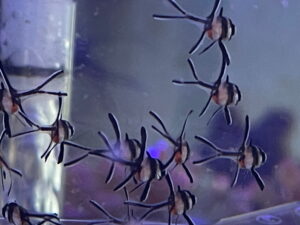
Banggai cardinal fry rearing is not difficult; it is just hard work. Repeated practice is necessary. This is not a trick; it is a series of processes. The processes include: produce, enrich, rotate, feed frequently, maintain cleanliness, observe, and adjust. If implemented in a home environment, these processes can create a small aquaculture lab.
Please follow and like us:


About Author
