Dissolved Organic Matter (DOM) is an essential and multi-faceted component of marine aquarium biogeochemistry. Through the control of microbial productivity, the alteration of the nutrient flux, and the exercise of significant control over the general stability of the ecosystem, DOM has an unavoidable role. For all that DOM is constantly cycled through natural reefs by the processes of simultaneous photochemical breakdown, microbial consumption, and biotic exudation, the marine aquarium has the limited buffering capacity of the open sea. DOM thus accumulates unless actively controlled and induces physicochemical perturbations, such as reduced transparency, enhanced nutrient inputs, and redox-sensitive destabilization of filtration processes.
In the current paper, DOM’s molecular complexity, source, functional dynamics, and evidence-based control measures for DOM are discussed critically for marine reef aquaria.
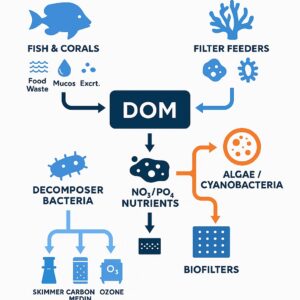
DOM is comprised of a chemically heterogeneous group of carbon containing compounds, virtually all <0.2 µm diameter. It extends from the labile through the refractory fractions and has both autochthonous and allochthonous fractions. Its primary components are:
- High and low molecular weight peptides and proteins
- Monosaccharides, oligosaccharides, and complex polysaccharides
- Saturated and unsaturated fatty acids, sterols, and phospholipids
- Organic acids, aldehydes, alcohols
- Aromatic compounds including humic and fulvic acids
- Polynucleotides, nucleosides, and microbial secondary
DOM constitutes a significant vector of carbon cycling in engineered reef ecosystems, particularly for Ultra Low Nutrient Systems (ULNS), where it serves as a primary electron donor for heterotrophic microbial consortia.
DOM origins in marine aquariums are the result of a complex set of trophic interactions, metabolical processes, and external inputs:
- Teleost and scleractinian coral epithelial mucous secretions: Protective and glycoprotein rich mucins, contributing
- Dissolution of detrital pellets and surplus alimentary inputs: A source of partially hydrolyzed macronutrients
- Necrobiotic turnover of the macrofauna, microfauna, and flora: Producing refractory DOM such as CDOM Chromophoric Dissolved Organic Matter *
- Metabolic exudates of algae and cellular autolysis: Supply dissolved organic carbon (DOC) and extracellular enzymes
- Bacterial lysis and quorum sensing excretions: Enhancing the pool of bioavailable low molecular weight
- Anthropogenic additions: Including liquid feeds, carbon dosing substrates (e.g., ethanol, acetate), and polymer based supplements
*CDOM stands for Chromophoric Dissolved Organic Matter, and it is the light-absorbing part of DOM that absorbs light primarily in the ultraviolet and blue ranges. It contributes to the coloration of the water, reduces light penetration, and is involved with photochemical and microbial processes occurring in marine ecosystems
In the context of the microbial loop framework, DOM acts as the basis for bacterial heterotrophy and the following trophic transfers. The sequential metabolism follows the order:
- Assimilation by heterotrophic bacteria of DOM allows for the growth and production of energy, producing ammonium (NH4+) as a by-product.
- Nitrification by chemolithoautotrophic taxa (e.g., Nitrosomonas, Nitrobacter) converts NH4+ to NO2 and subsequently to NO3.
- Denitrification within anoxic/hypoxic niches, such as the innermost part of the DSB matrix, reduces NO3 concentrations to gaseous nitrogen (N2).
Such a cascade connects DOM with processes of nitrogen transformation, controlling the stoichiometry of nutrients and propelling redox changes through sediment and biofilm microenvironments.
Properly controlled DOM concentrations play a range of key ecological functions:
- Filter feeding substrate supply for metazoans, such as sponges, ascidians, and azooxanthellate corals, that take up DOM
- Fuel for biofilm growth on stone surfaces and by means of microbial mats, with preference for nitrification/denitrification
- Facilitation of planktonic food webs, especially in systems with minimized particulate feeding regimens
- Regulation of carbon:nitrogen:phosphorus ratios, controlling microbial community composition and competitive interactions
- Redox sensitive nitrogen transformation enhancement, particularly for configurations of ULNS dependent upon bacterial export of nutrients
Unregulated DOM proliferation would have significant long term effects for aquarium biogeochemistry:
- Stimulation of phototrophic nuisance taxa: Elevated DOC concentrations potentiate blooms of filamentous algae and cyanobacteria via enhanced nutrient regeneration
- Optical degradation through CDOM: Photosynthetic efficiency is reduced by the buildup of aromatic and humic like substances, causing light attenuation
- Higher BOD (Biological Oxygen Demand): Respiration by the bacteria increases, depleting dissolved oxygen stores, particularly in stratified or low flow areas
- Compromised skimming effectiveness: Elevated surfactant like organics interfere with foam production, compromising protein skimmer effectiveness
- Microbial dysbiosis: Heterotrophic opportunists compete with nitrifiers, shifting biofilter performance and nitrogen transformation rates
DOM mitigation demands an integrative approach involving mechanical, physicochemical, and biotic treatments:
Physical Extraction
- High performance protein fractionators utilizing needle wheel or hybrid impeller technology for the removal of hydrophobic organics
- Mechanical prefilters with high surface area filter media that exclude POM prior to solubilization in DOM
Chemical Remediation
- Optimal pore structure granular activated carbon (GAC) for adsorption of aromatic and nonpolar DOM
- Ozonation reactors providing catalytic oxidative cleavage of macromolecular organics, restoring waterfront clarity and enhancing skimmer performance
- Synthetic adsorbent resins with specifically designed ion exchange properties for specific DOM fractions
Biological Assimilation
- Macroalgal refugia (e.g., Chaetomorpha, Gracilaria) to sequester nutrients derived from DOM mineralization
- Bacterial enrichment systems powered by zeolites, enriching high affinity heterotrophs for fast organic removal
- Addition of facultative filter feeders to biologically consume DOM or DOM associated microbial biomass
Preventative Measures
- Precise rationing and automatic feeding processes towards reducing organic waste input
- Scheduled partial exchanges of the water by diluting DOM and reasserting trace element equilibrium
- Analytical monitoring by way of TOC analyzers, fluorometry, or high resolution spectroscopy for real time DOM quantification
Dissolved Organic Matter is a complex and powerful governor of the function of reef aquariums. It is simultaneously a source providing support for microbial and invertebrate associations and also functions like a clandestine source of pressure that can upset chemical and ecological stability if not properly tempered. Through the use of a systems based managerial program utilizing advanced diagnostic tools and multispectrum dampening mechanisms, marine biologists and aquarium keepers can successfully temper DOM dynamics. This provides an opening for the optimization of the biogeochemical cycles, an increase in ecological resilience, and the attainment of long-term closed marine ecosystems successes.


About Author
