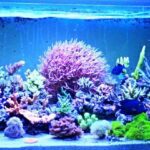
T5 fluorescent tubes were my first love in reefkeeping. Under a well-built T5 fixture, SPS corals grow evenly, colours look natural and there are no harsh shadows. When I was choosing the lighting for a new project, I went back through my old notes and found a comparison between LEDs and T5s that I had written years ago. Some of it still holds, some of it has aged badly. This is the updated, honest version.
The short answer: both technologies can grow excellent corals. What really matters is how much usable light reaches the corals (PAR), how evenly it is spread, and how stable it stays over time. The technology decides how easy or hard it is to get those three things right.
What corals actually need from light
Corals do not “see” watts or Kelvin. Their symbiotic algae (zooxanthellae) need photosynthetically active radiation, measured as PAR in µmol photons m−2 s−1, with a spectrum rich in blue. In a controlled study on Stylophora pistillata, blue light gave the highest survival, while red light alone reduced survival, symbiont density and chlorophyll content at higher intensity [1]. That is why both reef T5 tubes and reef LEDs are built around blue-dominant spectra.
If you want to go deeper into intensity, read PAR for the reef: understanding light intensity in your marine aquarium.
LED vs T5: point by point
1. Spectrum
T5: you build the spectrum by mixing tubes (actinic, blue plus, purple, coral plus and so on). It works very well, but changing it means buying new tubes. LED: separate channels (royal blue, blue, violet/UV, white, red, green) let you adjust the spectrum from the controller or app in seconds. That flexibility is useful, but it is also the most common way to get it wrong: too much blue at high intensity, or extreme settings copied from the internet.
2. Light distribution and shadows
This is where T5s are still excellent. A long tube is a diffuse, linear source: light reaches the tank from many angles, so the sides and lower branches of SPS colonies are lit too, with very few shadows. LEDs are point sources. Without good optics, enough fixtures or a wide spread, they create hotspots under the fixture and darker areas at the edges. Modern LED fixtures handle this much better than early ones, but on wide or deep tanks coverage still needs planning, and that often means more than one unit.
3. Intensity and PAR
In my old notes I wrote that LEDs are “more intense”. The more accurate way to say it: LEDs are very efficient at putting high PAR in a concentrated area, while good T5s with individual reflectors give a high and very even PAR across the whole tank. Either can burn corals if they are pushed too hard, and either can be too weak if the fixture is undersized. Measure with a PAR meter instead of guessing.
4. Energy efficiency
For the same useful light on the corals, a modern reef LED generally uses less electricity than a T5 fixture. The difference is largest on tanks that need high PAR for many hours a day.
5. Heat
Both produce heat. T5 tubes and ballasts release a lot of it right above the water, which can push tank temperature up in summer. LEDs also get hot, but the heat is concentrated in a heatsink, often with a fan, and less of it reaches the water. On a tank without a chiller, this can make a real difference.
6. Lifespan and stability
T5 output and spectrum drift as the tubes age. Most reefkeepers replace them on a fixed schedule, usually every 9–12 months and never all at once, to avoid a sudden jump in intensity. Quality LED diodes keep their output for many years. This long-term stability is one of the biggest real advantages of LEDs for SPS tanks.
7. Cost
A good LED fixture usually costs more upfront. T5s are cheaper to buy, but you pay again every year in replacement tubes and electricity. Over three to five years the gap often closes, or even reverses.
8. Control and automation
My old note said that some LEDs could not ramp or dim. That is no longer true. Almost every reef LED today has built-in sunrise/sunset ramps, moon light, cloud effects and app control. T5s can be dimmed only with dimmable ballasts and a compatible controller, and even then you control intensity, not individual colours.
9. Maintenance
T5: replacing tubes and cleaning reflectors and splash covers. LED: keeping the lens and fan clean. LEDs need less routine work, but they depend on electronics, so a failed driver or fan has to be repaired, not just swapped like a tube.
10. Shimmer and look
LEDs produce the “shimmer” effect that many people love. T5s give a softer, flatter light. This is personal taste and has nothing to do with coral health.


Quick comparison
| Aspect | LED | T5 |
|---|---|---|
| Spectrum control | Adjustable per channel | Set by the tube mix |
| Coverage and shadows | Needs good spread or multiple units | Very even, few shadows |
| Long-term stability | High | Output drops, tubes need replacing |
| Heat into the tank | Lower | Higher |
| Upfront cost | Higher | Lower |
| Running cost | Lower | Higher (energy and tubes) |
| Dimming and ramps | Built in | Only with dimmable ballasts |
What the research says about coral growth
There is no evidence that one technology is always better. In an industry-commissioned field test by Philips, a purple Acropora grew at about 1.7% per day under both a reference T5 fixture and an LED unit [2]. Because the test was funded by a manufacturer, treat it as an indication, not proof, but it agrees with what many reefkeepers see: matched PAR and a good spectrum give similar results. In another study on Acropora cervicornis, corals under a commercial reef LED calcified more than corals under natural sunlight at matched maximum PAR, while photosynthetic efficiency was higher under sunlight [3].
The lesson is simple: intensity, spectrum and stability matter more than the technology.
Hybrid fixtures: the best of both
Many SPS keepers combine both: LEDs for spectrum control, ramps and shimmer, and two to four T5 tubes for even coverage and fewer shadows. It costs more and produces more heat, but it is one of the most reliable ways to light a demanding SPS tank.
My practical advice
- Pick by tank shape: on long, shallow tanks T5s or hybrids spread light very well. On cubes or nano tanks a single good LED is usually easier.
- Measure PAR at the top, middle and bottom of the rockwork before and after any lighting change.
- Change slowly. When you switch technology, start at a lower intensity and raise it over a few weeks so the corals can acclimate.
- With T5s, replace tubes on a schedule, one or two at a time.
- With LEDs, don’t overdo blue and intensity just because the controller allows it.
Conclusion
T5s are still a great choice for even coverage and natural-looking colour. LEDs win on efficiency, stability, control and lower heat. Today, for most new reef tanks, a good LED or a hybrid fixture is the most practical option. But a tank lit by well-maintained T5s at the right PAR will grow corals just as well. Choose the system you can measure, tune and keep stable.
References
- Wijgerde, T., van Melis, A., Silva, C. I. F., Leal, M. C., Vogels, L., Mutter, C., & Osinga, R. (2014). Red light represses the photophysiology of the scleractinian coral Stylophora pistillata. PLoS ONE, 9(3), e92781. https://doi.org/10.1371/journal.pone.0092781
- Wijgerde, T. (2016). CoralCare LED unit: final field test report. Coral Publications, commissioned by Philips Lighting.
- Growth, calcification, and photobiology of the threatened coral Acropora cervicornis in natural versus artificial light (2021). Zoo Biology, 40(3), 201–207. https://doi.org/10.1002/zoo.21589