A coral in your tank sits in water full of oxygen, dissolved carbon and nutrients. Yet it can run short of oxygen at night, or be slowed down by its own oxygen during the day, only a millimetre or so from that rich water. The reason is a thin, almost motionless skin of water that clings to every coral surface: the boundary layer. Water flow is what thins that skin, and that is why water flow matters far more than “keeping the water moving”. In a microsensor study on a Favia coral, this layer was about 0.2–0.3 mm thick at 5–6 cm/s but more than 1 mm thick in stagnant water [1].
This article goes deeper than my earlier, more practical post, Mastering the Flow: the importance of proper flow in a marine reef tank. Here we look at why flow changes coral physiology, what the studies measured, and seven practical steps for your reef tank flow.
The boundary layer, simply explained
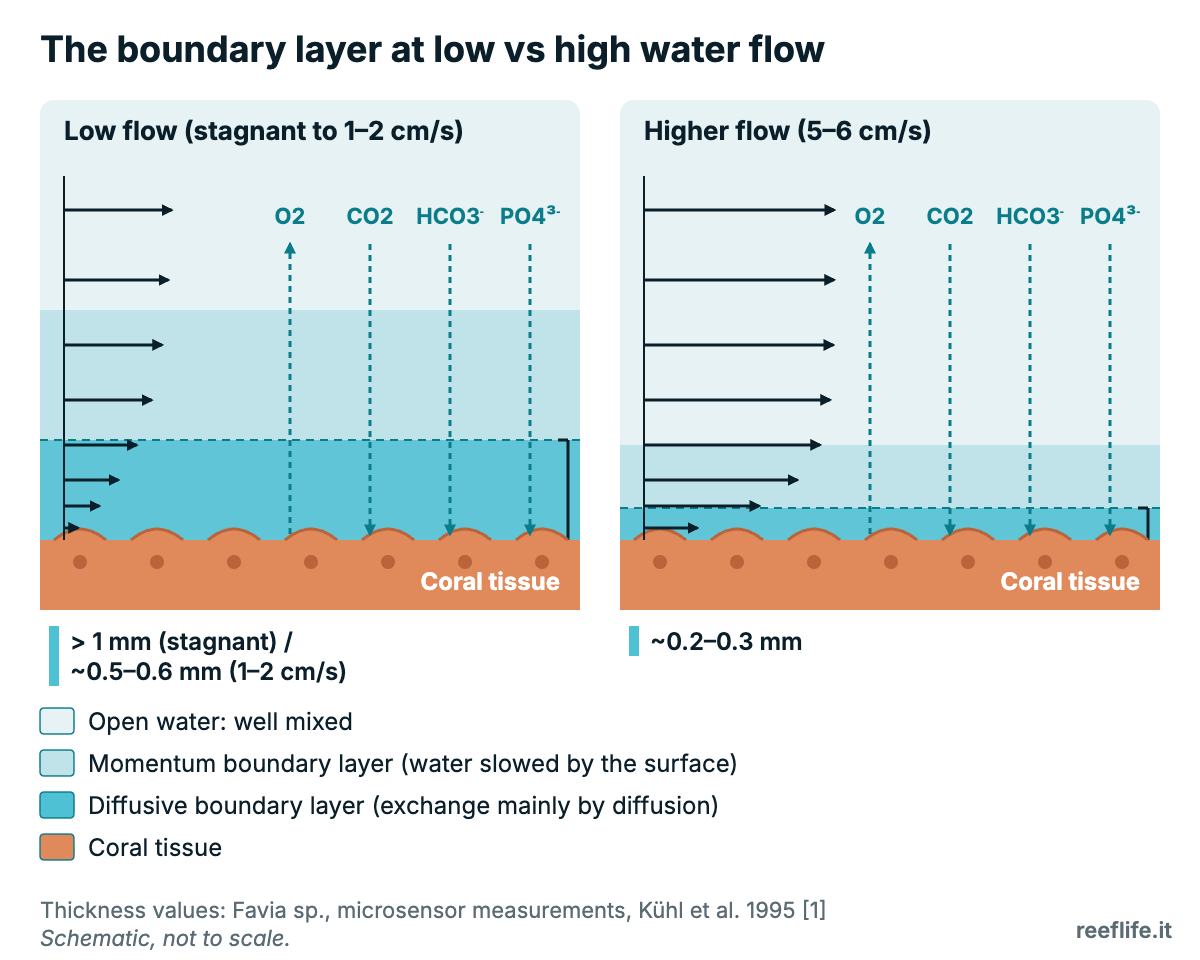
When water moves past a surface, friction slows the water touching it almost to a stop; further out it speeds up to the open-water velocity. Two layers are worth knowing:
- The momentum (velocity) boundary layer is the zone where the water speed is reduced by the surface.
- The diffusive boundary layer (DBL) is a thinner zone right against the tissue, where water movement is so slow that dissolved gases and ions cross it mainly by molecular diffusion, which is slow.
Everything a coral exchanges with the water has to cross the DBL: oxygen and carbon dioxide, bicarbonate for photosynthesis and calcification, and nutrients such as phosphate. The thicker the layer, the slower the exchange. Faster water flow makes the layer thinner [1][3].
What microsensors measured on real corals
How thick is the boundary layer?
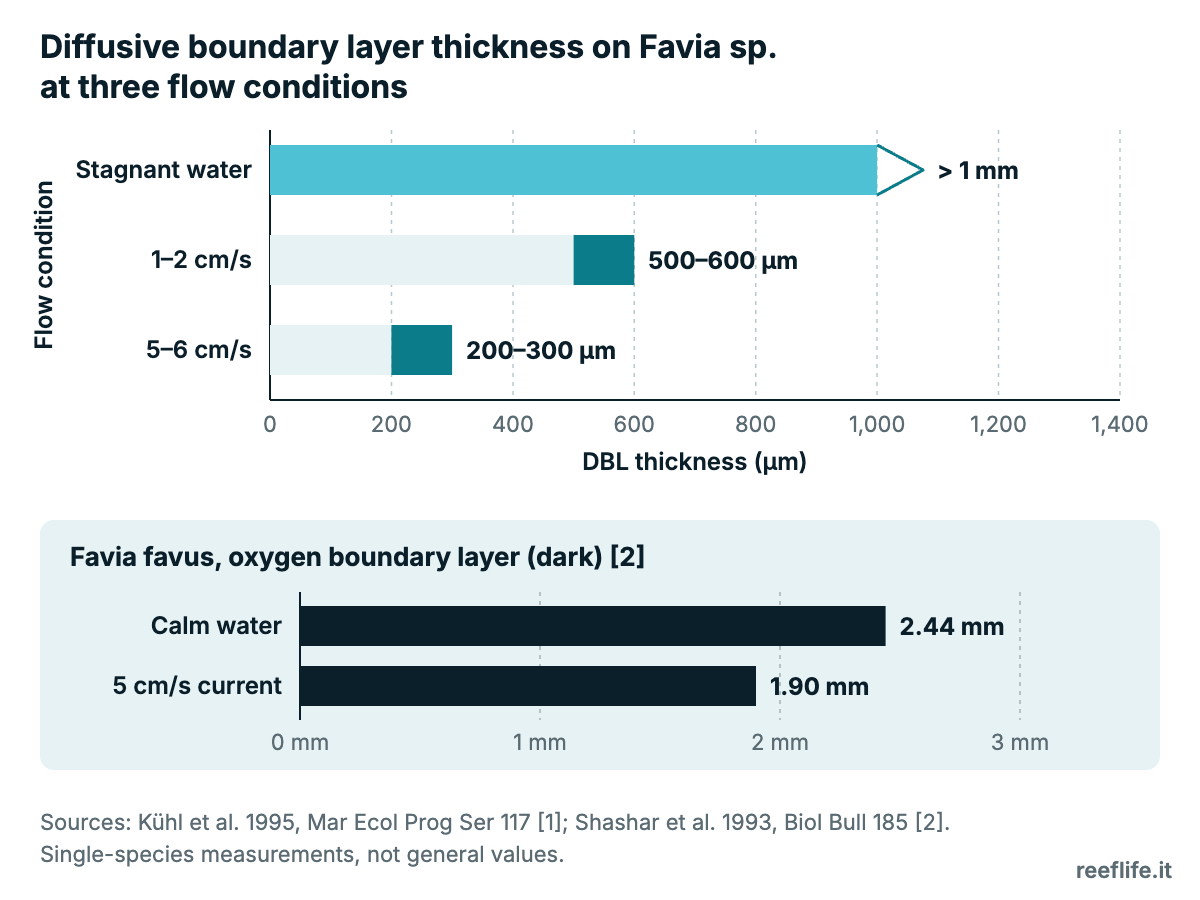
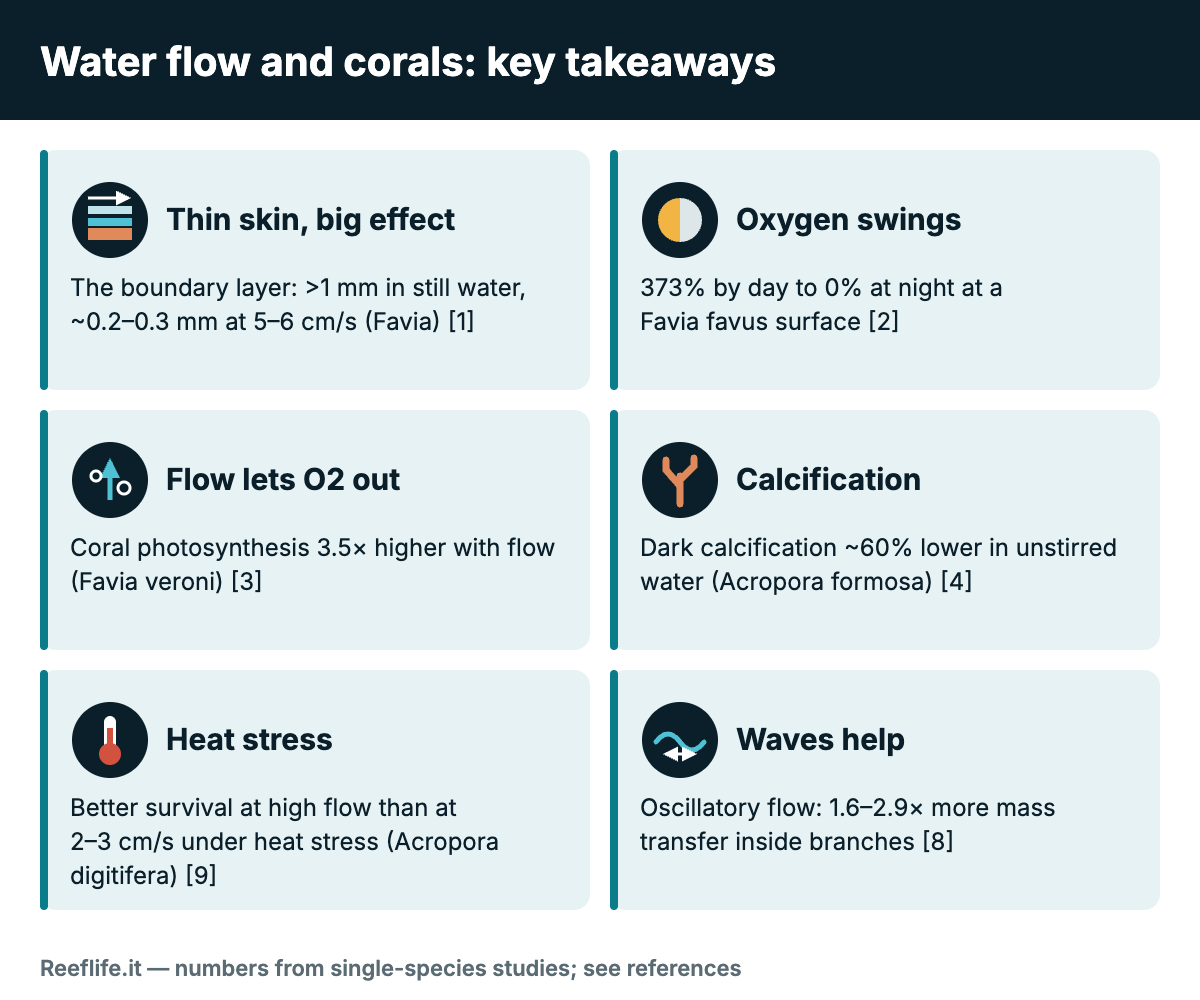
Kühl and colleagues used oxygen and pH microsensors, with tips finer than a hair, on corals from the Gulf of Aqaba (Eilat) [1]. On Favia sp. they found that the DBL was about 200–300 µm thick at a flow of 5–6 cm/s, about 500–600 µm at 1–2 cm/s, and over 1 mm in stagnant water [1].
Two years earlier, Shashar, Cohen and Loya measured oxygen boundary layers on several Red Sea stony corals [2]. In calm seawater in the dark, the layer ranged from about 4.0 mm in Platygyra lamellina to about 1.5 mm in Porites lutea [2]. A 5 cm/s current reduced the layer on Favia favus from 2.44 mm to 1.90 mm, and the authors noted that the DBL “remained continuous” even with the current on [2]. In other words, flow thins the boundary layer, but it never removes it completely. In massive corals the layer also tended to be thicker on species with larger polyps (calyces) [2].
Oxygen: from supersaturation by day to near-anoxia at night
Inside the DBL, water chemistry can be very different from the water a few millimetres away.
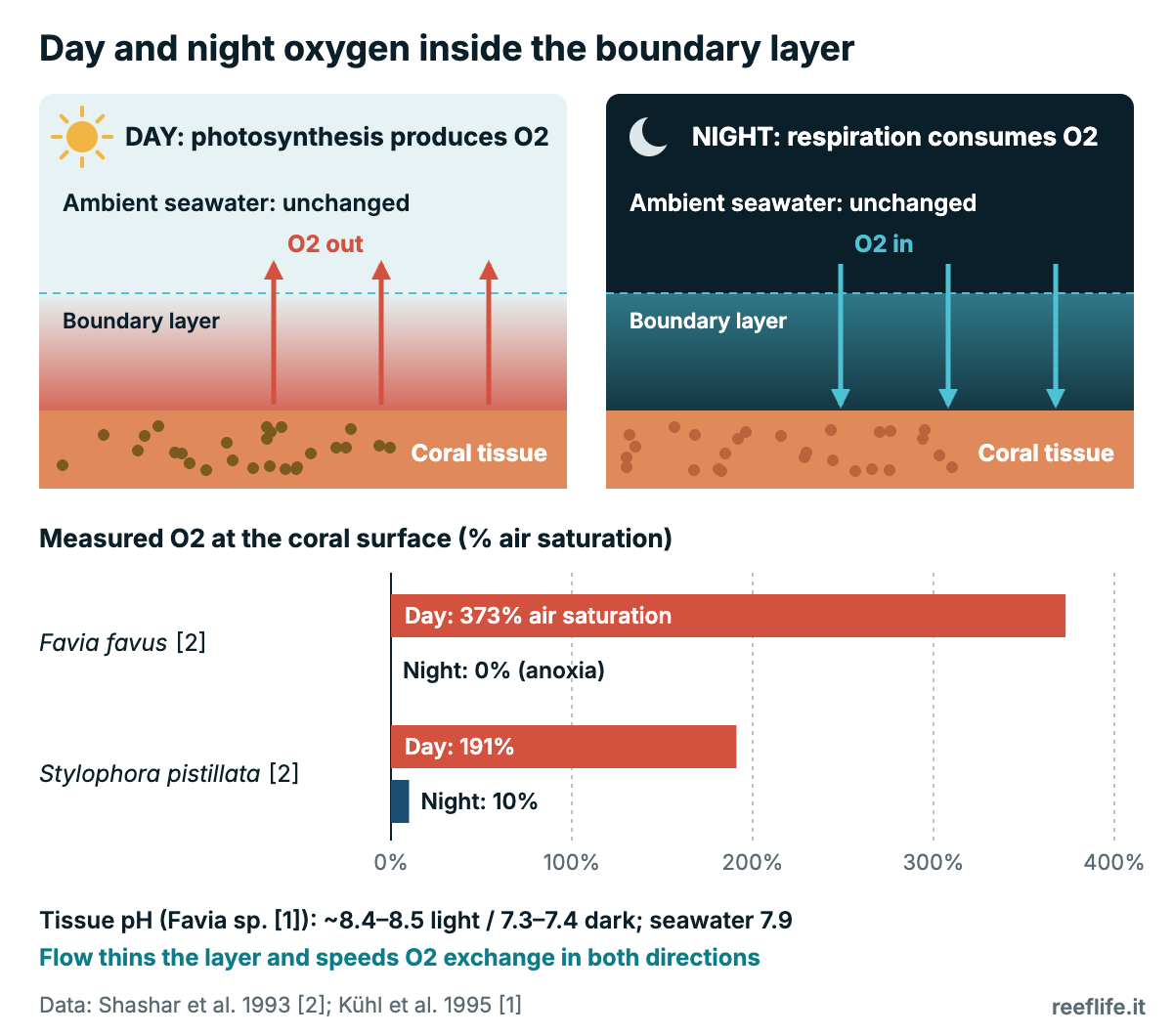
- In the light, oxygen at the surface of Favia favus reached 373% of air saturation; at night it fell to zero, complete anoxia, while the surrounding water stayed constant [2]. In the branching Stylophora pistillata the figures were 191% by day and 10% at night [2].
- In Favia sp., oxygen in the tissue rose above 250% of air saturation within minutes of light, and fell below 2% within minutes of darkness [1]. Tissue pH swung from about 8.4–8.5 in the light to 7.3–7.4 in the dark, against an ambient seawater pH of 7.9 [1].
- The same study showed that the flow-dependent DBL limited dark respiration: at night, the coral’s oxygen supply was set by how fast oxygen could diffuse in through the boundary layer [1].
So in still water a coral may be “drowning” in its own oxygen by day and short of oxygen at night, even if your test kit shows perfect values in the open water.
Water flow and coral physiology: what the studies show
Photosynthesis: flow helps oxygen get out
The usual explanation was that flow brings more CO2 and nutrients in. Mass and colleagues (2010, PNAS) tested this on three benthic autotrophs from Eilat: the coral Favia veroni, the red alga Gracilaria cornea and the seagrass Halophila stipulacea [3]. With flow switched on, photosynthesis was on average 3.5 times higher in the coral, 1.9 times in the alga and 2.5 times in the seagrass than without flow, and oxygen inside the organisms dropped by 32–45% [3]. In the coral, the oxygen efflux was about 2 µmol O2 m⁻² s⁻¹ with flow versus about 0.3 µmol O2 m⁻² s⁻¹ without [3].
Doubling bicarbonate under no-flow conditions had no effect on photosynthesis (n = 3 per species tested) [3]. The authors concluded that, in their experiments, neither nutrients nor dissolved inorganic carbon limited this rapid response. Instead, removing oxygen increased the affinity of RuBisCO, the carbon-fixing enzyme, for CO2. High internal oxygen favours photorespiration, which they identified as the main cause of lower photosynthesis without flow [3]. This links directly to your symbionts; if you need a refresher, see my post on zooxanthellae.
Earlier work points the same way. In laboratory incubations of the Australian coral Acropora formosa, net photosynthesis and respiration were about 25% lower in unstirred than in stirred water [4]. In the field, Patterson, Sebens and Olson used an underwater flow respirometer on the Caribbean coral Montastraea annularis and found that primary production and dark respiration increased with water motion [5].
Calcification
In the same Acropora formosa study, dark calcification was about 60% lower in unstirred conditions; light calcification looked about 25% lower, but that difference was not statistically significant [4].
A longer aquarium-style experiment on Galaxea fascicularis nubbins compared high flow (15–25 cm/s) with low flow (5–10 cm/s) at two light levels, 300 and 600 µmol photons m⁻² s⁻¹ [11]. There was a significant interaction between light and water flow for all growth measures: flow mattered more for skeletal growth as light increased, and higher flow increased net photosynthesis [11]. Practical point: if you push PAR (see PAR for the Reef), flow has to keep up.
Nutrient uptake
Atkinson and Bilger placed reef-flat communities in a 9.3 m flume and pumped water over them at 13 speeds between 2.3 and 58 cm/s, with phosphate raised to about 2 µM [6]. Phosphate uptake increased with water velocity (the log of the rate coefficient rose with the log of velocity, slope about 0.76), and they concluded that uptake was controlled by diffusive boundary layers near the organisms’ surfaces [6]. On a wave-dominated reef flat in Kāneʻohe Bay, Hawaii, Falter and colleagues estimated that phosphate uptake was occurring near the limits of mass transfer [7].
Bleaching and thermal stress
In mini-flumes at Sesoko Island, Okinawa, branches of Acropora digitifera were exposed to high temperatures (26.2–33.7 °C) and high light (about 95% PAR) at either high flow (50–70 cm/s) or low flow (2–3 cm/s) [9]. Survival was high at high flow and low at low flow, where branches bleached and died within 8 days; at temperatures below 30 °C there was no mortality under either flow [9]. The authors suggested that flow-driven differences in passive diffusion may partly explain why nearby reefs fared so differently in the 1998 bleaching event [9].
A field mini-flume study adds a mechanism [10]. In Agaricia agaricites, photosynthetic efficiency rose 8% from still water to 15 cm/s, but this effect reversed when ambient oxygen was high; Montastraea annularis showed no detectable change [10]. The authors proposed that water motion helps remove oxygen from coral tissue at peak photosynthesis, reducing oxidative stress [10]. More background on bleaching is in my coral bleaching intro.
Note the scope: these are a handful of species, under specific lab or field set-ups. They show a consistent direction, not a universal flow number for “all corals”.
Laminar, turbulent and oscillatory water flow
- Laminar flow moves in one direction in smooth, parallel layers.
- Turbulent flow contains eddies that mix water towards the surface and help thin the boundary layer.
- Oscillatory flow is back-and-forth movement, like waves over a reef.
Branched corals are a special case: in steady one-way flow, water slows down inside the colony. In a laboratory flume using skeletons of Stylophora pistillata, Pocillopora verrucosa and Porites compressa, mass transfer inside the branches was only 50–75% of that outside [8]. Under oscillatory flow, relative mass transfer within the colonies was 1.6 to 2.9 times greater than under equivalent unidirectional currents, and at short wave periods (1–2 s) it reached up to 130% of the free-stream value [8]. For a reef flat, Falter and colleagues, drawing on dissolution experiments with rough artificial surfaces, estimated mass transfer only about 1.3–1.4 times higher under oscillatory than steady flow, and called this difference minor compared with the effect of flow speed itself [7].
This is the scientific case for alternating and pulsed water flow in a reef tank. Aquarium pumps do not recreate real waves, so treat this as a direction, not a recipe.
What this means for your tank: 7 steps for better reef tank flow
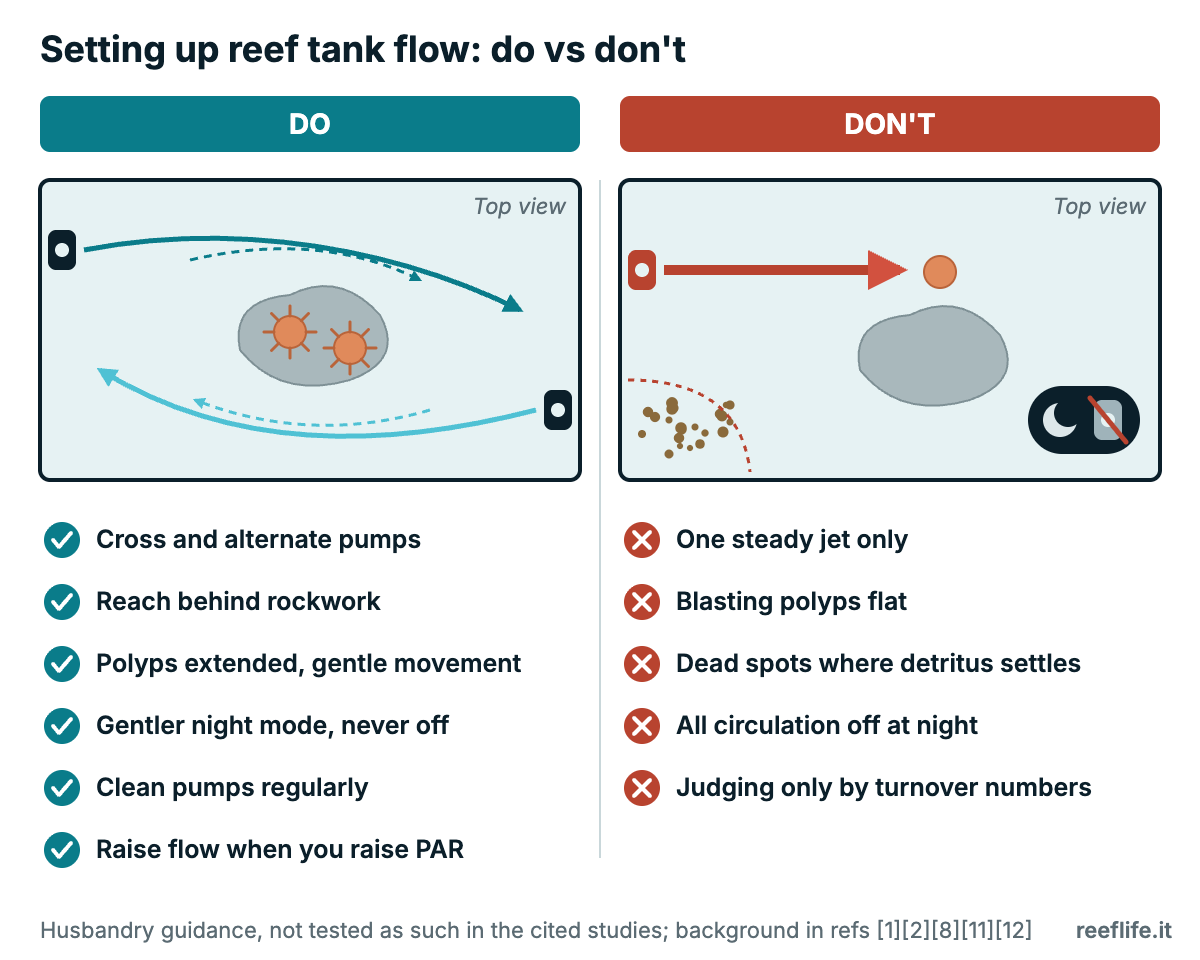
These steps translate the science into practice. They are husbandry judgement, not numbers from the studies above.
- Aim for chaotic, changing water flow, not one strong jet. Cross two or more pumps, or use alternating or pulse modes, so water hits corals from different directions. In a lab flume, back-and-forth (oscillatory) flow pushed more water through branched coral skeletons than steady flow did [8].
- Hunt down dead spots. Detritus settling in the same corners, behind rockwork or between branches is a visible sign that water flow is too weak there. Hobby literature also links accumulated organic material to problems in low-flow areas [12].
- Do not blast polyps flat. A coral pinned down by a jet with polyps retracted is not benefitting. The goal is a thinner boundary layer, not tissue damage. Watch for polyp extension and gentle, irregular movement.
- Place corals by flow, then adjust. Many SPS from shallow, wave-swept reefs usually tolerate stronger, more chaotic flow; many large-polyp LPS do better with moderate, indirect flow. Move pumps or corals based on how each colony behaves.
- Match flow to light. If you raise PAR, check flow too: in Galaxea, the benefit of flow grew with light [11].
- Think about the night. Oxygen inside the boundary layer can fall towards zero in the dark [1][2]. Do not switch circulation pumps off overnight; a gentler night mode is fine if it still mixes the whole tank.
- Maintain your pumps. Clean impellers and cages regularly; calcium deposits and algae steadily reduce output, so a setup that worked a year ago may now be weaker.
Myths about water flow
Myth 1: “More flow is always better.” Studies show benefits as flow rises from very low levels [3][4][9], but none of them prove that “maximum” is best for every coral. Flow strong enough to keep polyps retracted or to tear tissue defeats the purpose.
Myth 2: “The turnover number is what matters.” Hobby articles often quote rules of thumb, such as moving “at least 10 times the volume of the aquarium per hour” [12]. This is a starting guideline from hobby experience, not a figure derived from coral studies. Two tanks with the same turnover can have completely different boundary layers depending on where the flow goes.
Myth 3: “One strong laminar pump is enough.” Steady one-way flow leaves the inside of branching colonies under-supplied: in a lab flume, mass transfer inside the branches was only 50–75% of that outside [8]. Oscillatory flow raised it 1.6–2.9 times [8]. Alternating and crossing pumps are a practical way to move towards varied flow, but they were not tested in that study.
FAQ
How much water flow do corals need?
No study gives one number for all corals. Very low flow (around 1–3 cm/s, or still water) thickened the boundary layer on Favia [1] and was linked to lower respiration, photosynthesis or heat-stress survival in the species tested [1][4][9]. In practice, set flow so polyps stay extended, tissue moves gently and no detritus settles.
What is the boundary layer on a coral?
It is a thin skin of slow-moving water on the coral surface where gases and nutrients move mainly by diffusion. On Favia sp. it ranged from about 0.2–0.3 mm at 5–6 cm/s to over 1 mm in still water [1].
Is random flow better than constant flow?
In a lab flume, oscillatory flow increased mass transfer inside branched coral skeletons 1.6–2.9 times compared with equivalent one-way flow [8]. Varied flow is therefore a sound goal.
Can good water flow prevent bleaching?
Not if the tank overheats. In one Acropora digitifera experiment, high flow improved survival at high temperature compared with low flow [9], but temperature control comes first.
Should I turn pumps off at night?
Avoid switching all circulation off: microsensor studies found oxygen near the coral surface falling close to anoxia in the dark in still or slow water [1][2].
Summary
Water flow matters because of the boundary layer, a thin skin of water that slows every exchange between coral and seawater. Microsensor studies show this layer thickens from fractions of a millimetre to over a millimetre as flow drops, and that oxygen inside it swings from strong supersaturation by day to near-anoxia at night [1][2]. Flow increased photosynthesis mainly by helping oxygen escape [3], raised respiration and dark calcification [4][5], increased phosphate uptake [6], and improved heat-stress survival in one Acropora experiment [9]. In a lab flume, oscillating water flow reached inside branched coral skeletons better than steady flow [8]. In the tank: create chaotic flow, remove dead spots, avoid blasting polyps, match flow to light, keep circulation running at night and maintain your pumps.
References
- Kühl, M., Cohen, Y., Dalsgaard, T., Jørgensen, B. B., & Revsbech, N. P. (1995). Microenvironment and photosynthesis of zooxanthellae in scleractinian corals studied with microsensors for O2, pH and light. Marine Ecology Progress Series, 117, 159–172. https://doi.org/10.3354/meps117159 (full text: https://pure.mpg.de/pubman/item/item_3154399_1/component/file_3163696/Kuehl_1995.pdf)
- Shashar, N., Cohen, Y., & Loya, Y. (1993). Extreme diel fluctuations of oxygen in diffusive boundary layers surrounding stony corals. Biological Bulletin, 185(3), 455–461. https://doi.org/10.2307/1542485
- Mass, T., Genin, A., Shavit, U., Grinstein, M., & Tchernov, D. (2010). Flow enhances photosynthesis in marine benthic autotrophs by increasing the efflux of oxygen from the organism to the water. Proceedings of the National Academy of Sciences, 107(6), 2527–2531. https://doi.org/10.1073/pnas.0912348107
- Dennison, W. C., & Barnes, D. J. (1988). Effect of water motion on coral photosynthesis and calcification. Journal of Experimental Marine Biology and Ecology, 115(1), 67–77. https://doi.org/10.1016/0022-0981(88)90190-6
- Patterson, M. R., Sebens, K. P., & Olson, R. R. (1991). In situ measurements of flow effects on primary production and dark respiration in reef corals. Limnology and Oceanography, 36(5), 936–948. https://doi.org/10.4319/lo.1991.36.5.0936
- Atkinson, M. J., & Bilger, R. W. (1992). Effects of water velocity on phosphate uptake in coral reef-flat communities. Limnology and Oceanography, 37(2), 273–279. https://doi.org/10.4319/lo.1992.37.2.0273
- Falter, J. L., Atkinson, M. J., & Merrifield, M. A. (2004). Mass-transfer limitation of nutrient uptake by a wave-dominated reef flat community. Limnology and Oceanography, 49(5), 1820–1831. https://doi.org/10.4319/lo.2004.49.5.1820
- Reidenbach, M. A., Koseff, J. R., Monismith, S. G., Steinbuck, J. V., & Genin, A. (2006). The effects of waves and morphology on mass transfer within branched reef corals. Limnology and Oceanography, 51(2), 1134–1141. https://doi.org/10.4319/lo.2006.51.2.1134
- Nakamura, T., & van Woesik, R. (2001). Water-flow rates and passive diffusion partially explain differential survival of corals during the 1998 bleaching event. Marine Ecology Progress Series, 212, 301–304. https://doi.org/10.3354/meps212301
- Finelli, C. M., Helmuth, B. S. T., Pentcheff, N. D., & Wethey, D. S. (2006). Water flow influences oxygen transport and photosynthetic efficiency in corals. Coral Reefs, 25(1), 47–57. https://doi.org/10.1007/s00338-005-0055-8
- Schutter, M., Kranenbarg, S., Wijffels, R. H., Verreth, J., & Osinga, R. (2011). Modification of light utilization for skeletal growth by water flow in the scleractinian coral Galaxea fascicularis. Marine Biology, 158(4), 769–777. https://doi.org/10.1007/s00227-010-1605-3
- “Advanced Beginnings: The Basics of Water Movement in the Reef Aquarium” (2003, hobby article; author not named on the page). Reefs.com. https://reefs.com/?p=208717
About the author: AVen keeps a reef aquarium and writes ReefLife, a blog about the biology and day-to-day care of marine reef tanks. More about ReefLife


About Author
