Amongst the algae that may appear in our reef tanks and belong to the green algae category; Bryopsis pennata is considered to be a challenging alga not necessarily because it is aggressive, but because it is capable of taking advantage of a certain imbalance in a normal aquarium system.
In my own tank, it represents a prime example of how the presence of biologically mature and well-run systems (including deep sand beds and bacterial balance) can experience times of transition during which the opportunity for algal growth presents itself.
The purpose of this post is to help people to understand what Bryopsis pennata really is, when and where such algae appear, and how to deal with them in a rational and safe way.
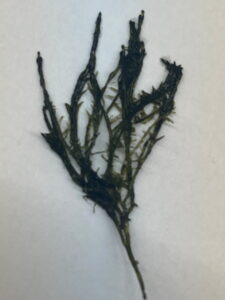
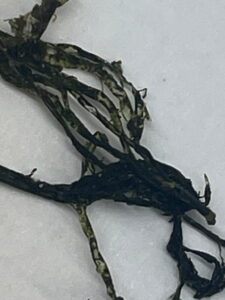
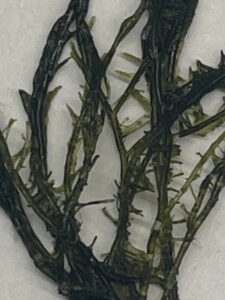
Bryopsis pennata typically shows:
- A distinct central axis
- Thin, irregular lateral branches
- A feather-like (pennate) structure, but not perfectly symmetrical
- Dark green to olive coloration
- Three-dimensional growth firmly attached to rock
Correct identification is essential, as it can easily be confused with:
- Derbesia: Simple filamentous algae
- Cladophora: Stiffer, more chaotic branching
- Caulerpa: Macroalgae with stolons and clear fronds
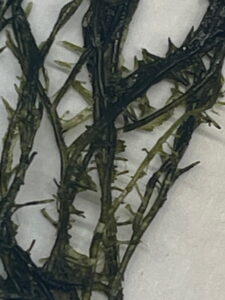
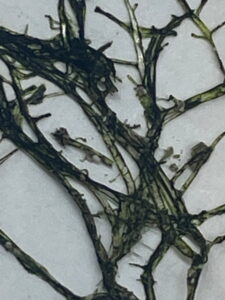
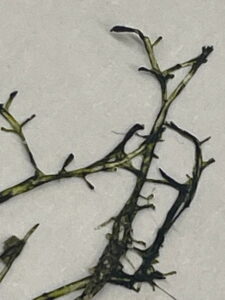
Important: Misidentification often leads to ineffective or counterproductive solutions.
In my tank, Bryopsis pennata did not spread everywhere. Instead, it appeared only on specific rocks and localized areas, which is an important educational point:
- Bryopsis does not colonize randomly, it exploits micro-zones with favorable conditions.
Its appearance coincided with a deliberate increase in nitrate (NO₃) levels, introduced to correct a period of ultra-low nutrients.
This leads to a key understanding:
- Transitional phases
- Rapid nutrient changes
An unstable NO₃ : PO₄ ratio
In my case, in my tank:
- NO₃ was rising
- PO₄ remained low or fluctuating
The biological system was still adapting and this become an ideal scenario for Bryopsis pennata.
One of the most frustrating things about Bryopsis is the lack of consumption by herbivores. For example in my tank are presents :
- Salarias,
- Mithraculus(crabs),
- Ctenochaetus
- Zebrasoma scopas.
However, none of the herbivorous species in the tank feeds on this algae. Despite the availability of known grazer species, Bryopsis is left untouched, which implies that the algae uses chemical defense compounds that make it unaesthetic to the herbivorous species.
As a consequence, manual removal became necessary.
Whenever manual operation is indicated, it must be done with especial care:
- The algae should be removed slowly and deliberately
- The grip should be applied as close as possible to the point of attachment.
- The filaments should never be allowed to fragment
Scientifically and practically speaking, the following explications have to be made:
- It manually removes Bryopsis without fully uprooting it, thus reducing visible biomass but not fully eradicating the Bryopsis at the
- Owing to its cellular structure and ability for regeneration, even microscopic quantities may be sufficient for regeneration in the case of rock environments where the algae are embedded, making physical removal a means of containing rather than eliminating the algal growth, particularly in environments where biological graze is not possible.
Of these methods that deal chemically in reef-keeping, there is only one that has proven effective in combating Bryopsis until now. That is why fluconazole is often cited in any discussion that seeks a remedy.
From my point of view, the use of fluconazole should never be considered a first line treatment. Because when dealing with a biologically complex environment, such as a reef aquarium with a deep sand bed, one must be prudent with chemical treatments.
Biochemically, fluconazole acts as a inhibitor of sterol biosynthesis within algal cells, a process that has a destabilizing effect on the cell membrane, leading to the decline of Bryopsis. The process is gradual as opposed to rapid, which makes it effective yet also implies that it has to be handled cautiously.
There are a number of key considerations which shaped my assessment of this option:
- Fluconazole should only be used within a settled, mature system, never during any phase of biological adjustment.
- It must be considered only as an ultimate measure after other aspects of balance, lighting, biological competition, and physical removal.
- It has a non-selective action, which means that beneficial macroalgae and other sterol-dependent organisms could also be affected.
Therefore, fluconazole is not a shortcut or remediation for improper system management. On the contrary, it is an effective strategy that carries the burden of responsibility: its application is only justified when the aquarium hobbyist is fully apprised of the cause and consequences surrounding the issue being addressed.
Seeing Bryopsis in your tank does not indicate a failure of the system. In my current tank, the observation is indicative, not of the instability/fluctuation of the system, but of the result of a management decision (I specifically increased the provision of food in order to improve the condition of the male Pterapogon kauderni. The intention was to foster pair bonding and reproductive success).
Although biologically valid and focused, the nutritional boost allowed for temporary localized changes in nutrient availability that contributed to favorable factors for Bryopsis colonization on a few rock surfaces.
I will continue to closely monitor the system and, to the extent that it is possible, physically remove the algae to control them.
At the same time, attention is also on creating conditions in favor of Bryopsis, instead of a reactive approach with respect to the occurrence of Bryopsis.
The aim is NOT to fight the algae but to create and keep a situation in which it cannot thrive.
This includes:
- keeping the nourishment level constant and controlled,
- allowing a sufficient period of time for the biological system to respond.
- and the avoidance of unnecessary chemical measures.
This management approach, with roots in deliberate practice, patience, and biological knowledge, reflects, in my own experience, the underlying tenet of education for success in the husbandry of marine-aquarium animals.


About Author
