
Water displacement movement can replicate natural conditions and supply oxygen and nutrients to marine organisms that live in the ocean. For this purpose, most aquarium keepers employ pumps to move and lift water.
Pumps for movement, also known as circulation pumps, are designed to create a flow of water in the aquarium. This water flow is of great utility for modelling natural conditions and offers multiple advantages, such as:
– Removal of waste and debris: An neustonic flow of water serves for the clearance of waste and debris from the aquarium, maintaining water cleanliness and overall health for the aquatic organisms.
– Distribution of nutrients: The water flow helps to spread the nutrients over the whole aquarium, so that no matter what the animals are, they have enough nutrients for living.
– Oxygenation: A bath flow of water is used to enhance the concentration of oxygen in the aquarium, which helps to provide an environment where the marine creatures can thrive.
Here are four pumps for movement that I recommend:
1. Ecotech Marine VorTech: This pump uses a magnetic mount and a quiet motor to create a powerful flow of water. It also boasts wireless control and therefore it’s simple to control the flow of water as needed.
2. Maxspect Gyre: This pump has a special crossflow technology to produce a natural flow of water that is soft and docile. It also has a compact design, making it easy to install in smaller aquariums.
3. Tunze Turbelle nanostream: This pump is assembled for small aquariums and operates on a propeller principle to produce a quiet pumping effect on water. One of its advantages is the compact design, therefore, it can be conveniently installed in restricted areas.Another interesting aspect with respect to previous ones are the easy steerability capabilities.
4. Jebao SOW: This is an inexpensive pump, and the type of the pump consists of a propeller design, which produces a flow of water. It is also a miniaturization type, which is easy to install and also easily point to a required location.


It’s important to understand the specific needs of the corals that you’re keeping. One crucial factor is the amount of water flow required for each type of coral.
SPS corals are considered some of the most challenging corals to keep due to their high flow requirements. To keep SPS corals healthy and thriving, you’ll need to provide a water flow of around 40-50 LPH per gallon of tank volume. (151-189 LPH per 3.785 liters of tank volume)
LPS corals, require less flow than SPS corals but still need a moderate amount to thrive. Aim for a water flow of around 20-30 LPH per gallon of tank volume for LPS corals(75-113 LPH per 3.785 liters of tank volume).
Soft corals, like zoanthids, require the lowest flow of the three types of corals. Aim for a water flow of around 10-15 LPH per gallon of tank volume for soft corals.(38-57 LPH per 3.785 liters of tank volume)
It’s important to note that these flow rates are just guidelines, and the specific needs of your corals may vary based on their individual requirements (Tank Shape, Coral position, density of corals). It’s also important to regularly monitor your water flow and adjust it as needed to ensure that all of your corals are receiving the appropriate amount of water movement.
One of the most important considerations is the placement of your flow pumps.

1. Create a circular flow pattern:
Ideally you would like to achieve a circular flow pattern whereby water cycles around the aquarium as a whole. This has the effect of spreading out the nutrients and avoiding dead zones where waste will build up. For this, position your flow pumps at the ends of the container, facing each other and tilt them in the center direction.
2. Vary the direction and intensity of the flow:
While a circular flow pattern is ideal, you also want to vary the direction and intensity of the flow to simulate natural ocean currents. This is conducive to developing healthy coral growth and inhibiting algae growth. In order to do this, it is suggested to have multiple flow pumps of varying capacities and power, and to test various angles and orientations.
3. Avoid blasting corals directly with flow:
Although flow is critical for coral health, and you don’t want to push coral directly with flow. This may lead to tissue damage and the coral fails to expand properly. Rather, site flow pumps so as to give a smooth, swirling current around your corals, without impinging on them.
4. Consider the overall aesthetics of your tank:
Although flow is a key factor in the health of your reef, it’s also wise to to keep the whole tank’s look in mind when placing your flow pumps. Try to position your pumps in a way that blends in with the natural look of your aquarium, without detracting from its beauty. Indeed, that point is good to have, but, of course, not a requirement.
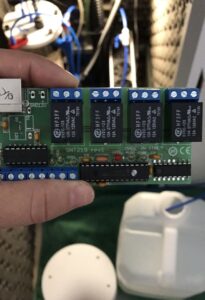
A couple of years ago, learning from a friend who gave me a lot of fun stuff to discover about this incredible hobby. He had a brilliant idea in my opinion. His marine aquarium is a dream of 1200 liters (Fantastic! He also intended to make some movement pumps synchronized so to generate waves and for this I have designed the relay shown below. A great experience.

An aid when in the tub is the lift pumps:
Lift pumps, or return pumps, are constructed to push water back into the aquarium from the sump or the filtration system. These pumps have a critical function in keeping a clean and balanced aquatic environment and offer a number of advantages, such as, which include:
– Filtration: Water movement in the water flow promotes drainage out of the filtration system, cleaning all the water that passed through.
– Stability: Continuous water flow facilitates the stability of the aquatic environment of marine organisms.
– Oxygenation: The wash of water increases the oxygen content in the aquarium resulting in a good living condition for the water animals.
Here are some pumps for lifting water that I recommend:
1. Ecotech Marine Vectra: This water pump is strong and has a very small motor for evacuating water from the sump that goes into the aquarium. It also has wireless control, making it easy to adjust the flow of water according to your needs.
2. Maxspect Turbine Duo 9K: This pump incorporates a dual-propeller concept to produce a high-intensity water flow. It is further equipped with small dimensions which means it can be easily fitted into smaller aquariums.
3. Tunze Silence 1073.050: This pump is intended foritarian aquariums and is equipped with a propeller that produces a quietwater current. It is also a miniaturized model that can be easily installed in small spaces.
4. Jebao DCW: This is an inexpensive pump that employs a DC motor to give a steady and energy-saving waterflow. It also has a controler, which is enabled you to adjust the flow rate and pump speed according to what is needed by your aquarium.
Pumps are an essential component of any marine aquarium. Pumps for movement and lifting (that is the removal of water) are crucial for promoting an inherently natural habitat, one that can support marine life in the right way. There are some aspects to consider, such as the scale of the aquarium, requirements for your marine life, and budget, when selecting a pump. If you choose the proper pump, you can keep your marine animals healthy in their tank.
Please follow and like us:


About Author
