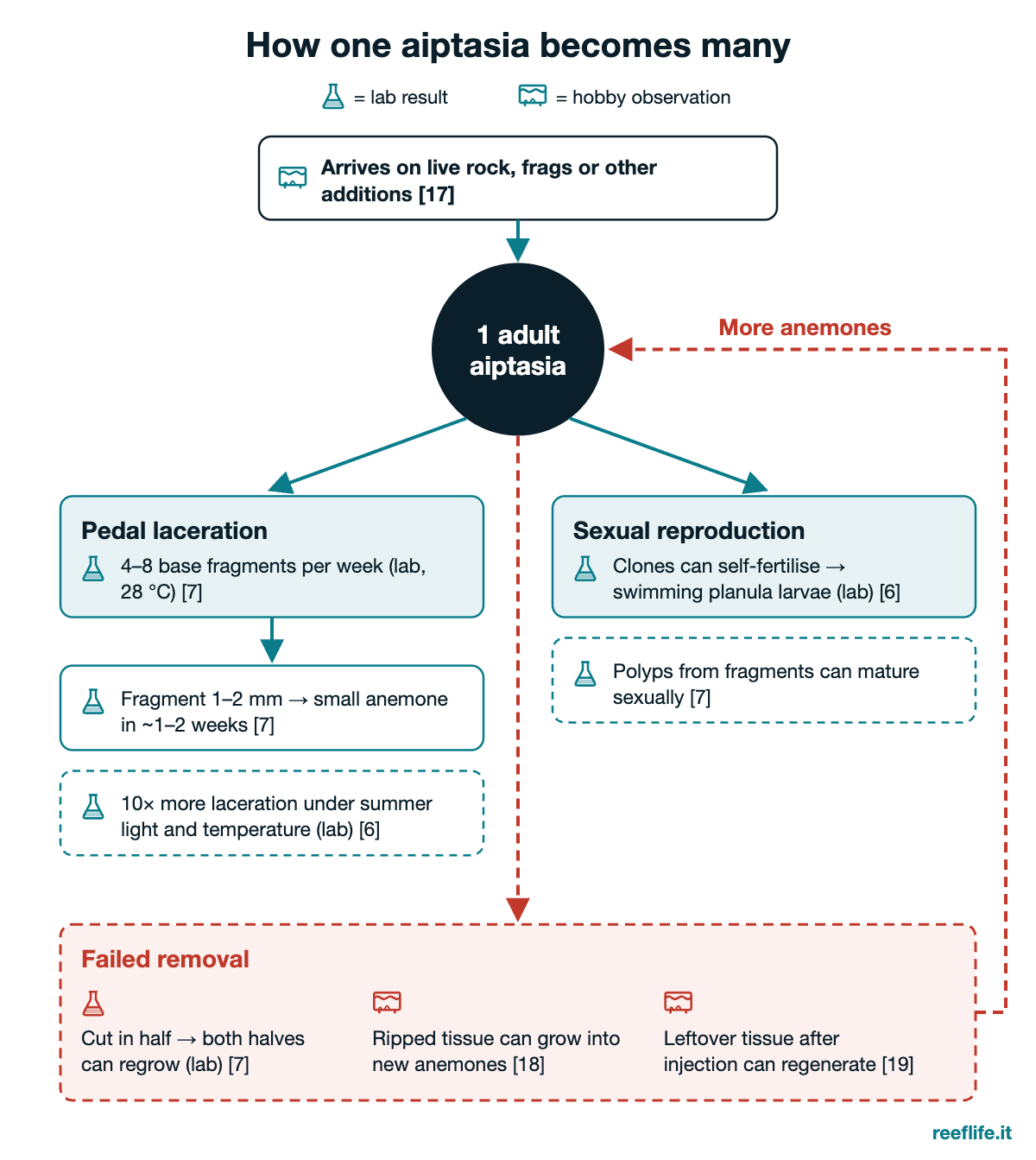
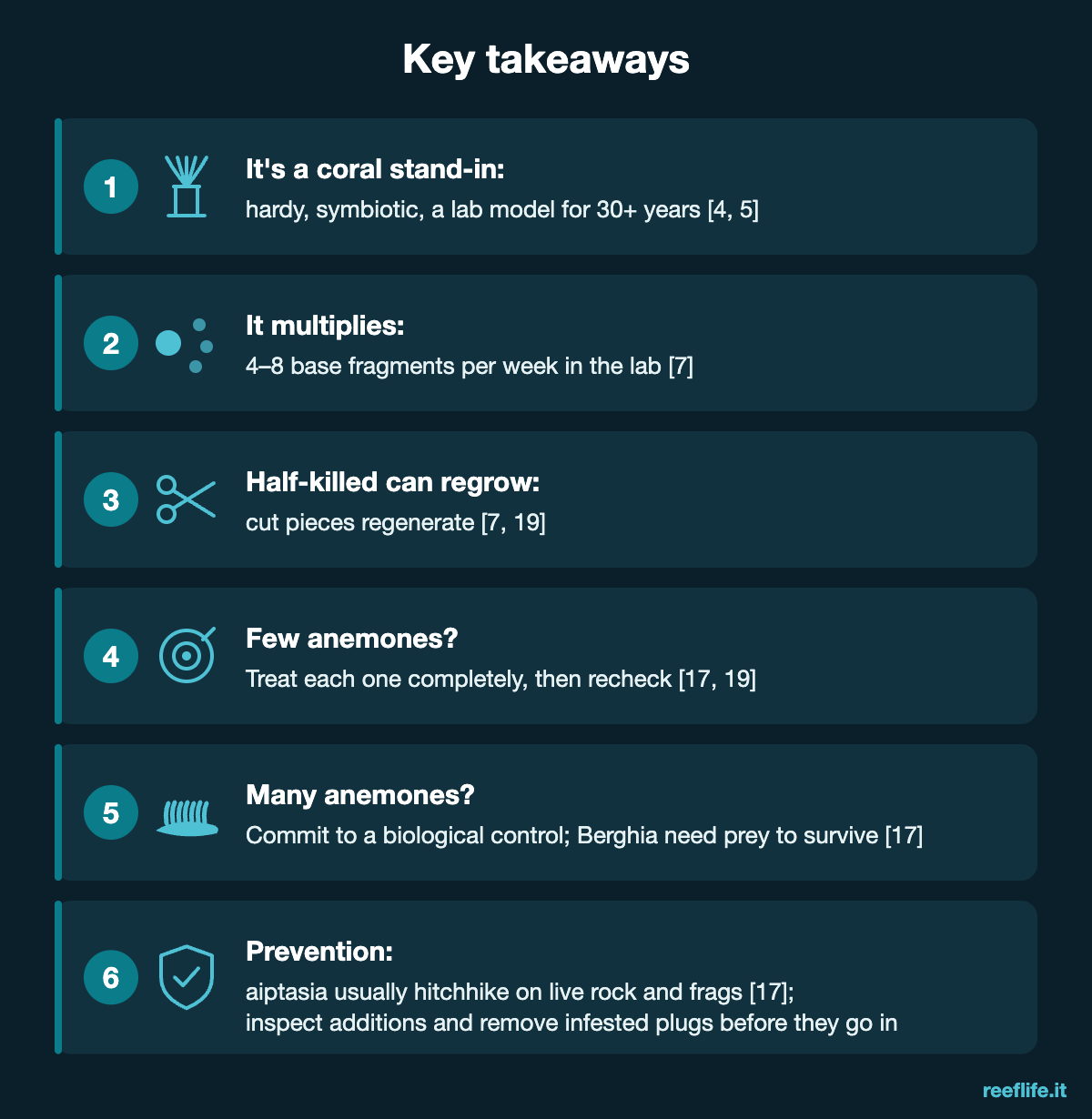
You spotted one small brown anemone on the rock, gave it a quick squirt, and forgot about it. A month later there are twenty. Aiptasia, the glass anemone, is built to turn damage into offspring. Reef writers warn that if a treated anemone is not completely killed, “the remaining tissue can regenerate resulting in many young anemones” [19]. Lab work points the same way. One anemone can shed four to eight pedal fragments a week, and both halves of an anemone cut in two can regrow into whole animals [7].
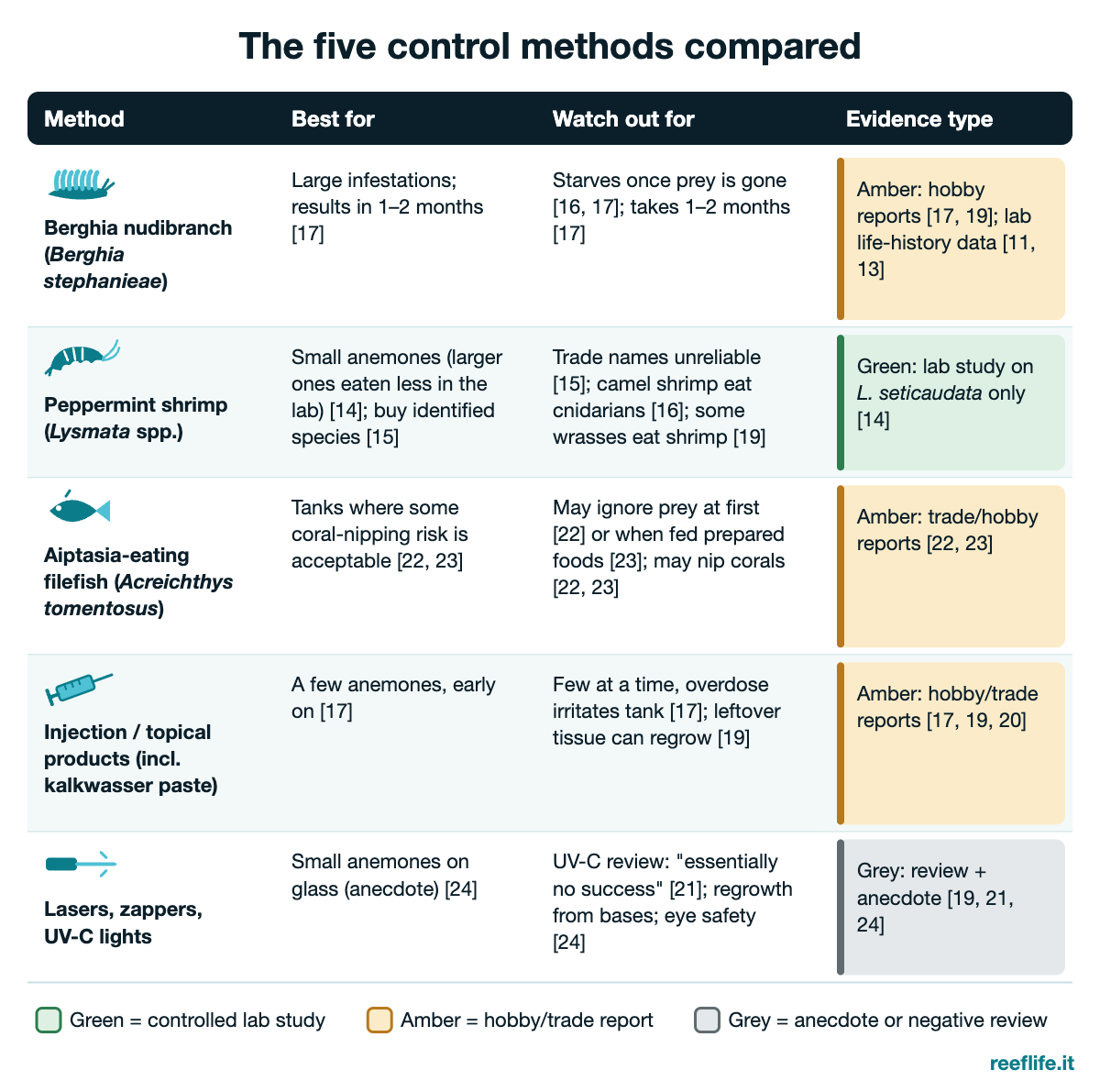
This guide explains what this pest is and why it spreads so fast. Then it compares five control methods (Berghia nudibranchs, peppermint shrimp, the aiptasia-eating filefish, injection products, and lasers or UV lights) against the evidence that actually exists for each one.
What Aiptasia actually is
The short version
“Aiptasia” is the hobby name for a small sea anemone that carries photosynthetic algae inside its tissues, much like many corals do. Its brown colour comes from these symbiotic algae (zooxanthellae) [16]. It is hardy [4], reproduces quickly and copes well with dim light [16]. Those same traits make it a pest in reef tanks and a favourite of scientists.
The name: Exaiptasia diaphana (or pallida)
In 2014, Grajales and Rodríguez revised the genus. They concluded that the animal long called A. pallida is “a single, widespread species from the tropics and subtropics” and moved it to a new genus, Exaiptasia [1]. Its species name has since been the subject of ICZN cases. Opinion 2404 (2017) declined to give pallida precedence over older names such as diaphana. A 2019 application asked for that decision to be reviewed, and the Commission ruled on it in Opinion 2500 (2023) [2]. Recent papers often use Exaiptasia diaphana [7, 13], older studies use Aiptasia pallida [10, 14], and some databases list E. pallida as the accepted name [9]. In your tank, they are one and the same animal.
Why researchers use it to study coral bleaching
Corals are difficult lab animals: they grow slowly and build skeletons [4]. This anemone, by contrast, “is extremely hardy, grows and reproduces rapidly via asexual reproduction in the laboratory”. It also hosts dinoflagellates “closely related to those in corals” [4]. Researchers can keep it symbiont-free or recolonise it with different Symbiodiniaceae strains, which lets them separate host effects from symbiont effects [4, 5]. It “has been a model system for coral research for over 30 years” [5]. Its genome was published in 2015 to support research on the symbiosis and its “susceptibility or resilience to stress” [3]. For background, see our articles on zooxanthellae and coral bleaching.
How one aiptasia becomes many
Pedal laceration: the main engine
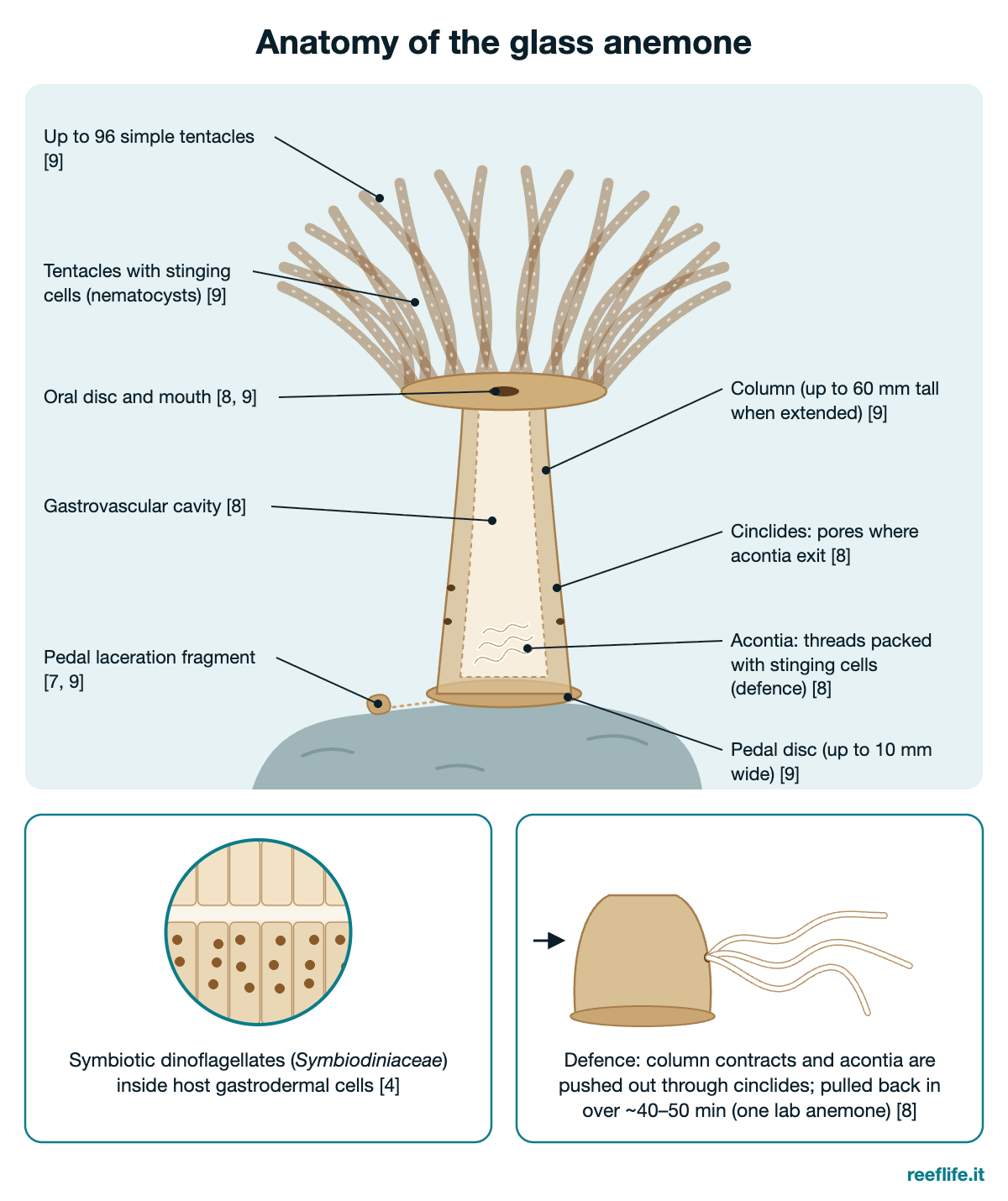
In pedal laceration, the anemone leaves small pieces of its base behind as it moves [9]. In a lab study at 28 °C, the anemones reproduced actively by pedal laceration. The fragments were 1–2 mm across, each individual produced four to eight of them per week, and each fragment became a small anemone within about 1–2 weeks [7]. Season matters too. In another lab study, pedal laceration was “ten-fold higher under summer photoperiod and water temperature conditions” than under winter conditions [6].
Sexual reproduction adds larvae
The species also reproduces sexually. Field-collected anemones had separate sexes. In the lab, clones grown from a single founder showed “sexual plasticity”, some became hermaphrodites, and they could “fertilize within and between clone lines, producing swimming planula larvae” [6]. Polyps produced by pedal laceration can themselves mature sexually [7]. So a tank that started with one hitchhiker can end up with a population that reproduces in more than one way.
Why poking, cutting and scraping backfire
The same regenerative power works against you when you attack an anemone by hand:
- In the lab, anemones cut in half regrew their missing parts. Survival was 61.5% for head pieces and 26.3% for trunk pieces after three months [7].
- Hobby writers warn that “a tiny speck that you might miss will likely survive and recover”. They add that bits left “stuck here and there on the substrate” are “the primary way you can end up with many Aiptasia from one” [16].
- Bulk Reef Supply warns that “you cannot just pull them out with your fingers or forceps”, because they retract too quickly, and that “if you rip some tissue, that can float about and grow into new anemones” [18].
None of this proves that every failed squirt makes twenty new anemones. It does explain why a half-killed anemone so often comes back as several.
Why aiptasia is a problem in a reef tank
Stinging cells and acontia
The anemone catches prey with nematocysts (stinging cells) on its tentacles [9]. It also has acontia, “thread-like tissue containing numerous stinging cells” kept inside the gastrovascular cavity [8]. When it is threatened, it contracts and forces the acontia out through small pores in the column called cinclides. In the representative anemone of six observed in the lab, pulling them back in took about 40–50 minutes [8]. Aquarium writers report that it “can sting many other cnidarians, including soft and stony corals” [16], causing “stress and potential death to nearby corals” [17].
It tolerates conditions your corals don’t like
Glass anemones often thrive “in areas where the lighting is quite dim” [16]. In a culture study, they did best at 26 °C in darkness, and Artemia nauplii gave more biomass than metanauplii [10]. What they eat affected how much they grew [10], and they can apparently also take up dissolved nutrients from the water [16], which is one more reason to keep an eye on nutrients in your reef aquarium.
Aiptasia control methods: what the evidence says
1. Berghia nudibranchs
The nudibranch sold as “Berghia” was described in 2005 as Aeolidiella stephanieae and is now called Berghia stephanieae [12, 13]. The animal long sold as Berghia verrucicornis is not that species [12]. Researchers now rear B. stephanieae on Exaiptasia as a model predator–prey pair [13].
What the lab work shows:
- A 1990 study cultured a Berghia (identified at the time as B. verrucicornis) on A. pallida. Eggs hatched after 11.6 ± 0.5 days at about 23.9 °C. Juveniles began feeding on the anemones three to four days after metamorphosis, and reproductive maturity came about 50 days after egg laying [11].
- Cultured B. stephanieae can lay “up to five spiral egg masses with hundreds of embryos per week” [13].
Bulk Reef Supply calls the Berghia nudibranch an “obligate aiptasia eater” and recommends it for serious infestations. It expects results in 1–2 months once the slugs reproduce and notes that they die off when their food runs out [17]. One Reef Builders author reports that Berghia “completely eradicated all Aiptasia” in a twenty-gallon nano tank “over the course of a few months” [19]. That is one tank, not a controlled trial. The main limits come with the slug’s specialisation: results take weeks to months [17, 19], and it starves once the prey is gone [16, 17].
2. Peppermint shrimp (and the species problem)
Peppermint shrimps “have been used for many years to control pest anemones” [15]. However, the shrimp traded as Lysmata wurdemanni turned out to be a group of species. In 2006, Rhyne and Lin redescribed L. wurdemanni and named four new species, including L. boggessi and L. ankeri [15]. They note that identifications of peppermint shrimp in field guides and aquarium magazines are not “based on taxonomic examination of actual specimens” and that the shrimps are “mostly traded as ‘L. wurdemanni’” [15]. Camel shrimp, sometimes sold in their place, are “notorious for feeding on various cnidarians” [16].
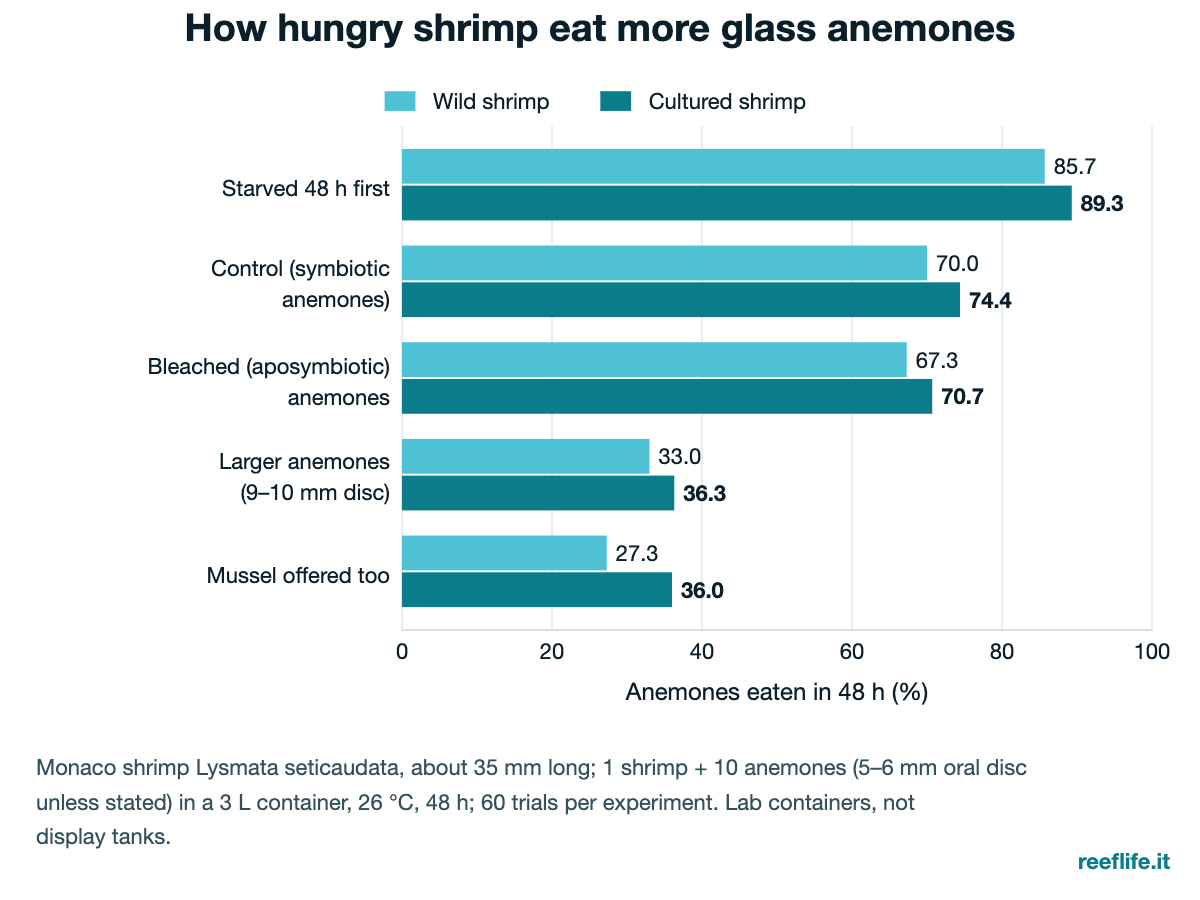
The best controlled data I could verify come from a different species, the Monaco shrimp L. seticaudata [14]. Each trial put one shrimp of about 35 mm in a 3-litre container with ten anemones for 48 hours at 26 °C [14]:
- Control: the shrimp ate 70.0% (wild shrimp) and 74.4% (cultured shrimp) of the anemones.
- After 48 h of starvation: 85.7% and 89.3%.
- Larger anemones (9–10 mm oral disc instead of 5–6 mm): 33.0% and 36.3%.
- With mussel offered as an alternative food: 27.3% and 36.0%.
The authors suggest starving shrimp during quarantine to improve control [14]. This was a small-container study of one Lysmata species. It does not show how shrimp perform in a large, rocky display.
3. The aiptasia-eating filefish (Acreichthys tomentosus)
This filefish does eat glass anemones [23]. ORA, which breeds it in captivity, says a new fish “may ignore Aiptasia for a week or two” before it starts. ORA also warns: “They have been known to nip at corals so be sure to keep them well-fed” once the anemones run out [22]. Reef Builders adds that “any fish that is capable of eating Aiptasia is also capable of eating coral polyps”, and that some owners’ fish ignored the anemones when they were fed prepared foods regularly [23]. In the wild, the species can reach about 6 inches [23]. I found no controlled study of this fish as a control method.
4. Injection and topical products
Commercial products and the classic DIY kalkwasser (calcium hydroxide) paste [20] work by “covering or injecting the aiptasia with a special paste-like solution” [17]. Each anemone has to be treated individually, a few at a time, because “too much solution can irritate your aquarium”. That makes the method best suited to early infestations [17]. The catch is the one this article opened with: the anemones “typically won’t just sit still” [16], and a partial kill can regenerate [19].
5. Lasers, zappers and UV lights
Reef Builders described an aiptasia laser and zapper as a tool that “seems to have the same effect as the syringe method” [19]. A 2022 review of a UV-C pest light reported “essentially no success at killing reef pests”. Anemones in rock or sand withdrew before treatment, and those on the glass tended to fall off rather than die [21]. On a hobby forum, reefers report regrowth from bases hidden in cracks and stress the need for eye protection with strong lasers [24]. These reports are anecdotal but fit the regeneration biology above.
What this means for your tank: a 5-step plan
- Prevent. Hitchhikers arrive “on live rock, coral frags, or other tank additions” [17]. Inspect every frag and rock with a torch before it goes in. If one carries an anemone, remove the plug or that piece of rock instead of treating it in the display. I found no evidence that standard coral dips kill these anemones, so don’t rely on one. (More on hitchhikers in live and dead rocks.)
- Act at the first anemone. “Take action as soon as you see even the smallest aiptasia” [18]. If the rock can come out, treat it outside the display so fragments don’t spread [18, 19].
- A handful of anemones: treat each one completely. Use an injection or topical product on only a handful of anemones at a time [17], and follow the product label. Check the same spot again over the following weeks, because survivors regenerate [19].
- Many anemones: go biological, and commit. Berghia eat only aiptasia and die off once it runs out [17], and in one tank they took a few months to clear it [19], so they suit larger infestations. Check your livestock first, because some wrasses eat peppermint shrimp [19]. If you choose shrimp, buy from a seller who identifies the species, and consider starving them for a day or two during quarantine (the lab study used 48 h) [14, 15].
- Fix the conditions that fed the outbreak. Glass anemones often thrive in dim areas [16], and in a culture study they did best in darkness at 26 °C [10]. Tighten feeding and nutrient export, as you would for nuisance algae such as Bryopsis.
Aiptasia myths
- “Just scrape it off.” Torn tissue and leftover base fragments can grow into new anemones [16, 18], and cut pieces regenerate in the lab [7].
- “Any peppermint shrimp will do.” Trade names are unreliable, and some look-alikes eat corals [15, 16].
- “Berghia will stay on as cleaners.” They depend on their prey and die off once it is gone [16, 17].
- “A filefish is a reef-safe magic bullet.” It may ignore the anemones or nip corals [22, 23].
- “They only grow under strong light.” Glass anemones thrive in dim spots, and in a culture study they did best in darkness [10, 16].
FAQ
Is aiptasia the same as the glass anemone?
Yes. “Glass anemone” is a common name for the same animal, now classified as Exaiptasia diaphana or E. pallida, depending on the authority [1, 2, 9].
How fast can glass anemones multiply?
In one lab study, each anemone produced four to eight pedal fragments per week, and each fragment became a small anemone within 1–2 weeks [7].
How many Berghia do I need?
None of the sources I checked gives a tested stocking number, so treat sellers’ recommendations as guidance only. Expect results to take 1–2 months or more [17, 19].
Will peppermint shrimp eat my corals?
One reef writer says they are “typically not a threat to any other cnidarians”, but camel shrimp sold under the same name are [16].
Can glass anemones hurt fish?
Reef Builders reports stings to some fish, such as seahorses [19].
Summary
Aiptasia is a hardy, symbiotic anemone that science uses as a stand-in for corals [3, 4, 5]. The same traits make it a tough reef pest. It reproduces both by pedal laceration and sexually [6, 7], it regenerates from pieces [7], and it stings its neighbours [16, 17]. For a few anemones, Bulk Reef Supply recommends treating each one individually with a paste or injection product [17]. For a large outbreak, Bulk Reef Supply recommends Berghia for serious infestations [17]. Aiptasia usually arrive as hitchhikers on live rock, coral frags and other additions [17], and Bulk Reef Supply advises keeping them out of the aquarium in the first place [18].
References
- Grajales, A. & Rodríguez, E. (2014). Morphological revision of the genus Aiptasia and the family Aiptasiidae (Cnidaria, Actiniaria, Metridioidea). Zootaxa 3826(1): 55–100. https://doi.org/10.11646/zootaxa.3826.1.2
- International Commission on Zoological Nomenclature. Opinion 2404 (2017), Bulletin of Zoological Nomenclature 74; and Case 3790 (Grajales & Rodríguez, 2019), Bulletin of Zoological Nomenclature 76. https://www.iczn.org/cases/all-cases/keyword/380 , https://www.iczn.org/cases/all-cases/case/3633 and https://doi.org/10.21805/bzn.v76.a036 ; Opinion 2500 (Case 3790) – Proposed review of Opinion 2404, Bulletin of Zoological Nomenclature 80 (2023). https://doi.org/10.21805/bzn.v80.a029
- Baumgarten, S. et al. (2015). The genome of Aiptasia, a sea anemone model for coral symbiosis. PNAS 112(38): 11893–11898. https://doi.org/10.1073/pnas.1513318112
- Lehnert, E.M., Burriesci, M.S. & Pringle, J.R. (2012). Developing the anemone Aiptasia as a tractable model for cnidarian-dinoflagellate symbiosis: the transcriptome of aposymbiotic A. pallida. BMC Genomics 13: 271. https://doi.org/10.1186/1471-2164-13-271
- Herrera, M. et al. (2020). Unfamiliar partnerships limit cnidarian holobiont acclimation to warming. Global Change Biology 26(10): 5539–5553. https://doi.org/10.1111/gcb.15263
- Schlesinger, A., Kramarsky-Winter, E., Rosenfeld, H., Armoza-Zvoloni, R. & Loya, Y. (2010). Sexual plasticity and self-fertilization in the sea anemone Aiptasia diaphana. PLoS ONE 5(7): e11874. https://doi.org/10.1371/journal.pone.0011874
- Shao, P.-J., Chiu, Y.-L., Tsai, P.-H. & Shikina, S. (2023). Possible germline progenitor cells in extra-gonadal tissues of the sea anemone, Exaiptasia diaphana. Frontiers in Marine Science 10: 1278022. https://doi.org/10.3389/fmars.2023.1278022
- Lam, J. et al. (2017). A detailed observation of the ejection and retraction of defense tissue acontia in sea anemone (Exaiptasia pallida). PeerJ 5: e2996. https://doi.org/10.7717/peerj.2996
- Smithsonian Environmental Research Center, NEMESIS database. Exaiptasia pallida species summary. https://invasions.si.edu/nemesis/species_summary/-1028
- Leal, M.C., Nunes, C., Engrola, S., Dinis, M.T. & Calado, R. (2012). Optimization of monoclonal production of the glass anemone Aiptasia pallida (Agassiz in Verrill, 1864). Aquaculture 354–355: 91–96. https://doi.org/10.1016/j.aquaculture.2012.03.035
- Carroll, D.J. & Kempf, S.C. (1990). Laboratory culture of the aeolid nudibranch Berghia verrucicornis (Mollusca, Opisthobranchia): some aspects of its development and life history. Biological Bulletin 179: 243–253. https://doi.org/10.2307/1542315
- Sea Slug Forum. Aeolidiella stephanieae Valdés, 2005 (species page). https://seaslugforum.net/find/aeolstep
- Silva, R.X.G., Madeira, D., Cartaxana, P. & Calado, R. (2023). Assessing the trophic impact of bleaching: the model pair Berghia stephanieae/Exaiptasia diaphana. Animals 13(2): 291. https://doi.org/10.3390/ani13020291
- Calado, R. & Narciso, L. (2005). Ability of Monaco shrimp Lysmata seticaudata (Decapoda: Hippolytidae) to control the pest glass anemone Aiptasia pallida (Actiniaria: Aiptasidae). Helgoland Marine Research 59: 163–165. https://doi.org/10.1007/s10152-004-0210-6
- Rhyne, A.L. & Lin, J. (2006). A western Atlantic peppermint shrimp complex: redescription of Lysmata wurdemanni, description of four new species, and remarks on Lysmata rathbunae (Crustacea: Decapoda: Hippolytidae). Bulletin of Marine Science 79(1): 165–204. https://research.nhm.org/pdfs/27306/27306.pdf
- Fatherree, J. The Salt Mix: Dealing with Aiptasia, the Prolific Pest Anemone. Tropical Fish Hobbyist Magazine. https://tfhmagazine.com/articles/saltwater/the-salt-mix-full291505
- Farnsworth, R. How to Get Rid of Aiptasia (Help! I Wrecked My Tank, Ep. 1). Bulk Reef Supply, updated 21 Feb 2025. https://bulkreefsupply.com/content/post/how-to-get-rid-of-aiptasia
- Farnsworth, R. Knock ‘Em Dead With Frank’s F-Aiptasia: Top FAQs. Bulk Reef Supply, updated 1 Dec 2021. https://www.bulkreefsupply.com/content/post/franks-f-aiptasia-top-faq
- Ehlers, A. (2016, 23 Aug). How to eliminate Aiptasia in aquariums. Reef Builders. https://reefbuilders.com/2016/08/23/how-to-eliminate-aiptasia-in-aquariums
- Gripp, R. (2007, 27 Mar). Aiptasia anemone removal by lethal injection (kalkwasser paste with syringe). Reef Builders. https://reefbuilders.com/2007/03/27/aiptasia-anemone-removal-by-lethal-injection-kalkwasser-paste-with-syringe
- Adams, J. (2022, 12 Apr). Reef Delete review: sound in concept but not in practice. Reef Builders. https://reefbuilders.com/2022/04/12/reef-delete-review-sound-in-concept-but-not-in-practice
- CORAL Magazine, with Dorton, D. (ORA) (2016, 18 Feb). ORA introduces captive-bred Aiptasia-eating filefish. https://coralmagazine.com/?p=1245701
- Reef Builders guest writer (2024, 14 Aug). Five fish that will eat Aiptasia nuisance anemones. https://reefbuilders.com/2024/08/14/five-fish-that-will-eat-aiptasia-nuisance-anemones
- Reef2Reef forum thread (hobbyist anecdote). Do Aiptasia lasers and wands work? https://www.reef2reef.com/threads/do-aptasia-lasers-and-wands-work.972430/
About the author
AVen writes Reef Life, the English-language reef aquarium blog at reeflife.it. Read more about the project on the Reef Life intro page.


About Author
